

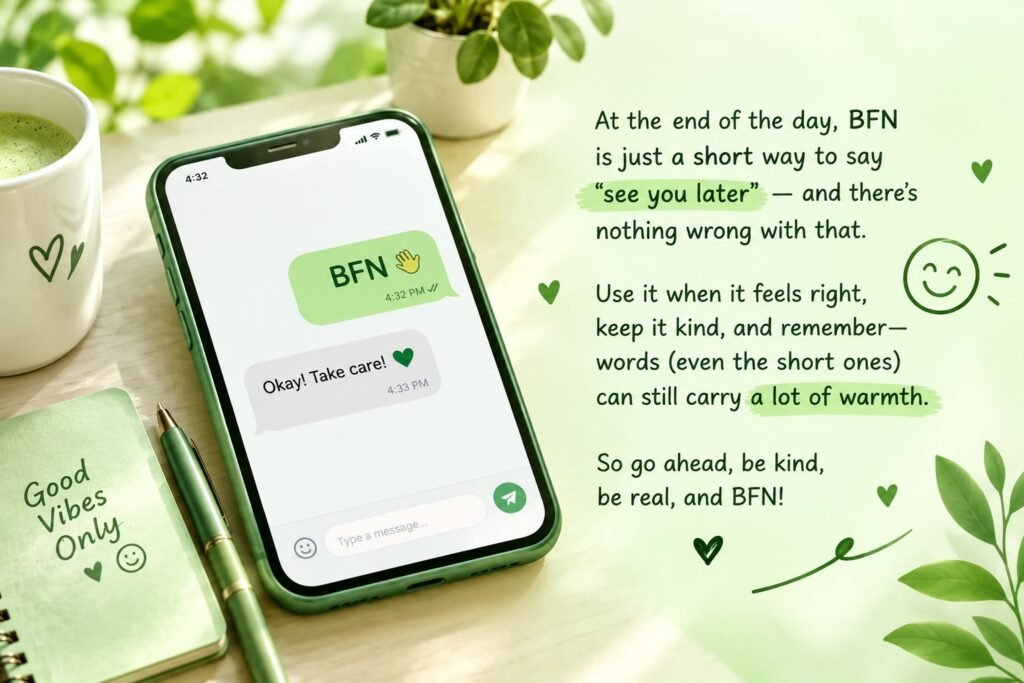
If you’ve ever ended a chat and gotten “BFN” back, you probably paused for a second. It looks like a typo or a name, and it’s easy to confuse with a similar abbreviation. The BFN meaning in text is simple, though: it stands for “bye for now.” It’s a light, friendly way to end a conversation while hinting that you’ll be back.
This guide covers what BFN means, where it came from, how it compares with other text slang for goodbye, and when it works (and doesn’t).
Table of Contents
What Does BFN Mean in Text?
In texting, chat and email, BFN is an abbreviation for “bye for now.” Major dictionaries list it as informal. Oxford Learner’s Dictionaries specifically notes its use in text messages and emails, and Collins labels it British.
The key word is now. BFN isn’t a permanent farewell. It says “I’m leaving this conversation, but we’ll talk again.” That’s why it suits ordinary goodbyes: you’re heading into a meeting, putting your phone down for dinner, or going to sleep.
Here is how it looks in practice:
- “Got to run, class is starting. BFN!”
- “Thanks for the help today, BFN.”
- “Dinner’s ready, BFN 😊”
It’s usually typed in capitals, though lowercase “bfn” is just as common in fast chats.
Where Did BFN Come From?
BFN seems to predate smartphones. It’s a shortened form of the spoken sign-off “bye for now,” and it sits in the same family as TTFN (“ta-ta for now”), which became popular in Britain in the 1940s through a character on the radio comedy It’s That Man Again.
British radio presenter Jimmy Young is credited with adapting that catchphrase into “BFN.” So the abbreviation likely began as an on-air sign-off before text messaging and chat rooms gave it a second life.
Nobody can say precisely when the first person typed “BFN” into a text box. What’s documented is the spoken catchphrase, its dictionary status, and its use as written shorthand.
Is BFN More Common in British English?
Probably, yes. Collins labels BFN as British, and its roots in UK radio and the TTFN tradition point the same way. In the US, shorthand like TTYL and GTG tends to be the more familiar choice, though this is a general observation rather than something backed by usage data.
The difference is one of familiarity, not correctness. A British reader may take BFN as a perfectly ordinary sign-off, while an American reader might need a moment to place it. If you’re texting someone across regions and aren’t sure, spelling out “bye for now” removes the doubt.
BFN vs. Other Goodbye Abbreviations: A Quick Comparison
BFN is one of several sign-offs, and each carries a slightly different message.
| Abbreviation | Stands for | What it signals | Typical situation |
| BFN | Bye for now | Casual goodbye, temporary | Ending a chat you’ll resume later |
| TTYL | Talk to you later | A specific promise to talk again | Wrapping up with a friend |
| BRB | Be right back | You’re stepping away briefly | Mid-conversation pauses |
| TTFN | Ta-ta for now | Playful, a bit old-fashioned | Light, humorous goodbyes |
| GTG | Got to go | You have to leave, perhaps abruptly | Quick exits |
The practical difference is how long you expect to be gone. BRB means minutes, BFN is vaguer and could be hours or a day, and TTYL implies a real follow-up conversation.
Quick Text Slang Glossary for Goodbyes
If you’re decoding a message and BFN isn’t the abbreviation you’re looking at, these are the other common sign-offs and exits:
| Abbreviation | Meaning |
| BBL | Be back later |
| BBS | Be back soon |
| BBIAB | Be back in a bit |
| G2G / GTG | Got to go |
| L8R | Later |
| CYA | See you / see ya |
| TTYL | Talk to you later |
| TTFN | Ta-ta for now |
Most of these sit on the same spectrum: some say you’re stepping away briefly (BRB, BBL, BBIAB), some say you’re leaving (GTG, G2G), and a few, like BFN and TTFN, are simply friendly goodbyes.
Real-Life Examples of BFN in Conversations
Seeing it in context helps more than a definition.
Between friends
“Heading to the gym, will message after. BFN!”
“Enjoy! BFN 💪”
With family
“Phone’s about to die. Love you, BFN.”
In a group chat
“Late shift tonight, so I’m off. BFN everyone.”
In a quick work chat (informal team)
“Call at 3? Great, BFN.”
Notice that none of these are heavy or emotional. BFN works best when the goodbye is routine.
How to Reply to a BFN Message
You don’t need to reply with BFN yourself. Anything friendly that fits the mood works:
- Mirror it: “BFN!” or “BFN 👋”
- Say it plainly: “Bye for now, talk soon!”
- Add warmth: “Take care, speak later!”
- Keep it casual: “Catch you later!”
- Let it go: If the conversation has clearly ended, a thumbs-up or a simple emoji is enough.
If the sender is leaving because of something stressful, a short “Take care of yourself” says more than any abbreviation.
When Should You Use BFN?
Use BFN when:
- You’re chatting with friends, family or close colleagues who know the slang.
- The conversation will likely continue later.
- The tone is relaxed.
- You want a shorter alternative to “bye for now” in a quick message.
A few simple guidelines help:
- Know your audience. If the other person is older or isn’t a heavy texter, they may not recognize it (though British readers often will).
- Match the mood. It fits cheerful or neutral chats better than serious ones.
- Don’t overuse it. If every message ends with a slang sign-off, it loses its charm.
What Does BFN Mean in Zepeto
Zepeto is an avatar-based social app where users chat while their characters hang out in virtual worlds. Because chat there is fast and typed on a phone, abbreviations are common.
BFN in Zepeto means the same thing as everywhere else: “bye for now.” I didn’t find a separate, Zepeto-specific definition. Players typically use it when leaving a world or ending a chat with friends, as in “BFN guys, school time!” The platform doesn’t change the meaning, only the setting.
Common Mistakes People Make With BFN
Most BFN mix-ups come down to a few habits:
- Reading it as a name or typo. Context usually clears this up, since it appears at the end of a message.
- Confusing it with BFF. More on that below.
- Assuming it’s a final goodbye. It literally says “for now,” so it isn’t one.
- Using it in formal writing. It’s informal, and in a client email or job application it can look careless.
- Expecting everyone to know it. Slang ages and varies by region and generation. If unsure, spell it out.
Does BFN Have Any Other Meanings?
In texting, BFN is nearly always “bye for now,” but outside messaging the letters are used in other ways:
- BfN is the German Federal Agency for Nature Conservation (Bundesamt für Naturschutz).
- BFN is the IATA airport code for Bram Fischer International Airport in Bloemfontein, South Africa.
- Big Fat Negative appears in fertility and pregnancy forums, where it means a negative pregnancy test result. It’s an emotionally sensitive context, so read the surroundings carefully.
If you meet BFN in a chat, a business document, a travel itinerary or a health forum, the setting tells you which meaning applies.
Look-Alike Abbreviations to Watch For
A few other short sign-offs resemble BFN closely enough to cause mix-ups:
- BFF means “best friends forever,” which is a label, not a goodbye (covered in the next section).
- BBN is sometimes read as “bye bye now,” but it’s far less established than BFN and doesn’t appear in the major dictionaries I checked, so context matters more.
- TTFN (“ta-ta for now”) is BFN’s older cousin and means essentially the same thing.
When two abbreviations differ by one letter, check the sentence around them. A goodbye usually comes at the end of a message, while a friendship label sits in the middle of one.
BFN vs. BFF: Why People Mix These Up
The two share two of their three letters, and both appear in friendly chats, so the confusion is understandable. They mean very different things:
- BFN = bye for now
- BFF = best friends forever
One is a goodbye and the other a label for a close friend. A sign-off of “BFN” is leaving the conversation, while “BFF” is describing a relationship, as in “she’s my BFF.” If you see one in a spot where you’d expect the other, check for a typo.
Which One Should You Use: BFN, TTYL, or BRB?
A simple way to choose:
- Use BRB if you’re pausing the conversation and coming straight back.
- Use TTYL if you plan to continue the conversation, especially if you mean it.
- Use BFN if you want a soft, general goodbye without promising a time.
If you want one that never feels wrong between friends, TTYL is the more widely recognized option, while BFN adds a slightly more old-school, friendly flavor.
Sign-Offs by Formality Level
Abbreviations are only one end of the spectrum. Here’s how common goodbyes line up by how formal the setting is:
| Setting | Good options |
| Casual (friends, family, group chats) | BFN, TTYL, GTG, L8R, “Catch you later!” |
| Neutral (coworkers you know, quick emails) | “Talk soon,” “Speak later,” “Bye for now,” “Take care” |
| Formal (clients, job applications, official emails) | “Best regards,” “Kind regards,” “Sincerely,” “Thank you” |
A good rule: the more the relationship or situation matters, the more you should write the words out.
Is BFN Still Used Today?
Yes, but it’s not among the most prominent slang terms. Dictionaries still list it, and it turns up in casual messages, though I couldn’t find reliable data on exactly how often people use it, so I won’t guess at numbers. In practice, it’s more common among people who grew up with early text messaging and chat, and in British English, while younger users often prefer “bye,” “ttyl,” “gtg,” an emoji, or nothing at all.
That doesn’t make it wrong, just a little retro. If you use it with friends who get it, it’s perfectly natural.
A Quick Note on Tone: Does BFN Feel Distant?
Not usually. “Bye for now” is warm by design, since it suggests you’ll reconnect. The abbreviation is brisk, though, so in an emotional or tense conversation it can read as curt. A text like “I’m upset about earlier… BFN” might feel like a brush-off.
If the moment matters, write the words out or add warmth: “Talk soon, take care!” is clearer than any abbreviation. For everyday chats, BFN is a friendly, low-stakes way to log off.
Frequently Asked Questions About BFN
What does BFN mean in a text message?
It means “bye for now.” It’s an informal sign-off, suggesting you’ll continue the conversation later.
Is BFN rude to use?
No. It’s a friendly, casual phrase. It could feel abrupt in a serious or emotional exchange, but on its own it isn’t rude.
Can I use BFN in professional emails?
It’s better not to. BFN is informal, and formal or client-facing emails are better served by “Best regards,” “Kind regards,” or “Talk soon.” You might use it in a relaxed chat with a coworker you know well.
What’s the difference between BFN and BRB?
BRB (“be right back”) means you’re briefly stepping away and will return to the same conversation shortly. BFN (“bye for now”) ends the conversation, with the expectation of talking again at some unspecified time.
Does BFN mean the same thing in Zepeto?
Yes. In Zepeto chat, BFN also means “bye for now,” and players use it when leaving a world or finishing a chat.
Is BFN the same as BFF?
No. BFN means “bye for now,” while BFF means “best friends forever.” They look alike but have nothing in common beyond a couple of letters.
What does BFN mean outside of texting slang?
It can refer to Germany’s Federal Agency for Nature Conservation (BfN), the airport code for Bloemfontein’s Bram Fischer International Airport, or “big fat negative” in fertility forums. In everyday messaging, it almost always means “bye for now.”
Is BFN still popular in 2026?
It’s still recognized and listed in dictionaries, but it’s not a trending term. It’s more common among older texters and in British English, and younger users often choose other sign-offs. I couldn’t find reliable usage figures, so treat that as a general observation.
Final Thoughts
BFN means “bye for now,” a friendly, informal goodbye that suggests the conversation isn’t over. It has roots in a British radio catchphrase, it means the same thing in Zepeto as in any text thread, and it shouldn’t be confused with BFF. Use it with friends and family, skip it in formal emails, and choose a longer sign-off when the moment calls for warmth. Used in the right place, it’s a small, polite way to say “see you soon.”
2 thoughts on “BFN Meaning in Text: What It Really Means and How to Use It Right”