

You get a message that ends with “jp” and you pause. Is it a typo? An abbreviation? A hint that something earlier was not serious?
In most chats, JP mean “just playing.” The sender is telling you the previous message was a joke, a tease, or not meant to be taken seriously. This guide covers where it came from, how it is used across apps, when it fits and when it does not, what else it can mean, and how to reply.
Definition and Meaning of JP in Text
What Does JP Meaning in text?
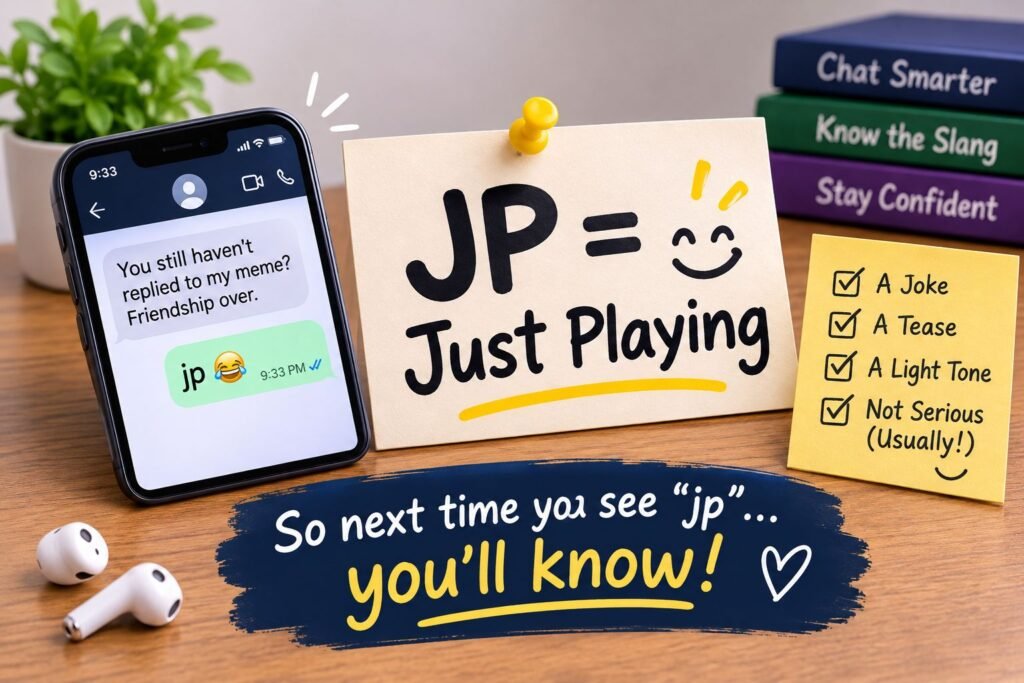
JP stands for “just playing.” People add it after a comment to soften it, flag it as a joke, or take back something that may have sounded too sharp.
It works as a small tone marker. Text has no facial expression or voice, so a harmless tease can land as an insult. “jp” fills that gap in two letters.
Simple Example
Person A: You still haven’t replied to my meme from yesterday. Friendship over.
Person A: jp 😂
Without “jp,” the first line might read as real annoyance. With it, the sender is clearly kidding.
Key Points About JP
- It stands for “just playing” (sometimes read as “just playin'”).
- It is informal and casual, mostly used among friends, peers, and in gaming or social apps.
- It usually comes at the end of a message, occasionally as a standalone follow-up.
- It is typically written in lowercase and often paired with an emoji.
- Tone matters: it can ease a joke, but it cannot undo a genuinely hurtful remark.
JP Meaning in Text and Chat
In direct messages, JP is mostly a joke flag. Used well, it lowers the stakes of a tease:
- “You’re late again, I’m replacing you with a clock. jp”
- “That outfit is a crime, jp, it looks great”
It is also used as a retreat. When someone senses a comment landed badly, a quick “jp” tries to walk it back. Whether that works depends on what was said.
JP Slang Meaning and Common Usage
As slang, JP sits in the same family as “JK” (just kidding). Both signal “don’t take that seriously.” JP leans a bit more playful or teasing, while JK often follows a fake-out or a small surprise.
Common uses:
- Ending a sarcastic or exaggerated comment
- Softening a playful insult between friends
- Flirting lightly without committing (“I’m leaving you on read forever. jp”)
- Clarifying that a dramatic statement was a bit
Background and History of JP Meaning in Text
There is no documented moment when “jp” was invented, so treat any exact origin story you see online with caution. What can be said reasonably is this: the phrase “just playing” is much older than texting, and shorthand like “jk,” “lol,” and “brb” spread through instant messaging, SMS, and early chat rooms, where typing was slow and character counts mattered. “jp” fits that same pattern of clipping a common phrase down to initials.
It never became as universal as “jk,” which is why many people still need to look it up.
Usage in Different Contexts
JP Meaning in Text Messaging
In SMS, iMessage, and WhatsApp, JP appears after teasing or sarcastic lines. It is usually one friend poking at another. Because texts can be read in any mood, many people add it as insurance.
Social Media
On Instagram comments, X, Snapchat, and TikTok, JP shows up in replies and captions, often attached to a roast or a dramatic statement. Example: “Nobody asked for another gym selfie. jp, looking good 🔥”
Gaming Chats
In team chat and voice-to-text, JP often follows trash talk. “Wow, thanks for feeding the other team, jp gg.” Because competitive chat can turn hostile quickly, a “jp” can keep banter from escalating. Be aware that in some games, “JP” can also refer to the Japanese server or region (more on that below).
Casual Conversations
Among friends and classmates, it is a light tone-setter. If you are already comfortable with someone, you may not need it, but it helps with people whose sense of humor you are still learning.
Professional Communication: Is JP Appropriate?
Generally, no. Work communication favors clear, neutral language, and slang abbreviations can look careless or leave readers guessing.
Situations Where JP Is Not Recommended
- Emails to clients, managers, or recruiters
- Formal Slack or Teams announcements
- Customer support replies
- Any message where a joke could be misread (feedback, deadlines, complaints)
Better Alternatives
Instead of “jp,” try:
- “Just kidding!”
- “That was a joke, of course.”
- “Only teasing, but I do appreciate the quick turnaround.”
When It Might Be Acceptable
In a relaxed team chat with close colleagues who already use slang, an occasional “jp” is unlikely to cause problems. Follow your workplace culture, and when in doubt, spell it out.
Hidden or Alternative Meanings
Context decides. Besides “just playing,” JP can mean:
- Japan or Japanese: the country code is JP, and gamers use “JP server” or “JP version.” If the conversation is about games, anime, or travel, this is likely the meaning.
- Initials: names like Jean-Paul, Jai Prakash, or John Paul are often shortened to JP. If someone is being discussed, it is probably a person.
- Justice of the Peace: a legal term, mostly in formal or official settings.
- Company or brand names: JP Morgan is the well-known example.
If a message with “jp” does not follow a joke, check the topic. A sentence like “Did you get JP’s number?” is about a person, not a joke.
Usage in Online Communities and Dating Apps
On dating apps, JP usually softens flirtation or banter: “You’re clearly the problem here. jp 😉.” It signals you are playful, not hostile. In Discord servers and Reddit threads, it works much like in gaming chat, though overusing it can make a message feel less confident.
Tips for Using JP in Online Conversations
- Use it only when a joke could be misread.
- Do not use it to excuse a comment that was actually rude.
- Pair it with an emoji if your tone is hard to read.
- Avoid it with people who may not know the slang.
- If you are unsure the other person will understand, write “just kidding” instead.
Comparison With Similar Slang
JP is one of many abbreviations that carry tone or intent. Here is how it compares with related ones.
10 Slang Terms Related to JP
- JK: “Just kidding.” The closest relative. It is more widely recognized and often used after a surprising statement.
- LOL: “Laughing out loud.” Shows amusement, but it does not retract a statement the way JP does.
- BRB: “Be right back.” A short pause in a conversation.
- TTYL: “Talk to you later.” A casual goodbye.
- LMK: “Let me know.” A request for a reply or update.
- IMO: “In my opinion.” Flags that a statement is a view, not a fact.
- TBH: “To be honest.” Often introduces a candid comment, sometimes a soft criticism.
- SMH: “Shaking my head.” Expresses disbelief or disappointment.
- IDK: “I don’t know.” A quick admission of uncertainty.
- DM: “Direct message.” A private message on a social platform.
Of these, only JK does nearly the same job as JP, and the two are mostly interchangeable in casual chat.
How to Respond to JP
Your reply depends on how the joke landed and how well you know the sender.
Casual Responses
- “Haha okay, you had me for a second.”
- “Lol fair enough.”
- “Got it 😄”
Funny Responses
- “Too late, I’ve already told everyone.”
- “I’m screenshotting that for later.”
- “Playing or not, I’m still offended.”
Neutral Responses
If the joke stung a bit and you want to be honest without a fight:
- “Okay, just so you know, that one was a bit much.”
- “Alright. Let’s keep it lighter next time.”
Professional Response
If a coworker uses it:
- “Understood, thanks for clarifying.”
- “No problem. Let’s get back to the report.”
Regional and Cultural Differences
Use of “jp” varies by age group, platform, and community, and I am not aware of reliable data showing exactly how common it is in different countries. In English-speaking online spaces, “jk” is far more recognized. In regions or games where “JP” refers to Japan, readers may take it that way first. Multilingual speakers sometimes mix English slang into other languages, so the same letters can carry different meanings depending on who is texting. When the context is unclear, a short “what do you mean by jp?” is perfectly normal.
Frequently Asked Questions
What does JP meaning in text?
It means “just playing.” The sender is saying the previous message was a joke or a tease.
Is JP the same as JK?
Mostly, yes. Both signal that something was not serious. JK (“just kidding”) is more common and often follows a surprise or a fake statement. JP leans toward playful teasing.
Is JP commonly used online?
It is used, but it is less common than JK or LOL. Many people only know it from specific friend groups, games, or apps.
Can JP mean something else?
Yes. It can refer to Japan or the Japanese server in games, someone’s initials (like Jean-Paul), Justice of the Peace, or a brand such as JP Morgan. The surrounding conversation usually makes it clear.
Is JP appropriate for work emails?
No. Use full phrases like “just kidding” in professional writing. Slang can seem unprofessional or confusing.
Why do people use JP in text messages?
Because tone is easy to misread in writing. A quick “jp” signals humor and helps prevent misunderstandings.
Conclusion
JP most often means “just playing,” a quick way to say a comment was a joke. It works best among friends, in casual chats, and in gaming or social spaces. It does not belong in formal or professional messages, and it cannot excuse something that was genuinely hurtful. If you see it outside a joking context, check whether it refers to Japan, a person’s initials, or something else. When in doubt, just ask, or write out “just kidding.”
1 thought on “JP Meaning in Text: What It Means in Chat, Social Media, and Online Slang ”