
You get a message that says “s/u” and stop for a second. Is your friend telling you to be quiet, or asking you to sign up for something? Both are possible, and context decides which.
In most texts, DMs, and comments, S/U meaning in text is “shut up.” It is a quick, lowercase shortcut that can be rude, playful, or just a reaction to surprising news. A few other meanings exist in school, work, and gaming, and this guide covers them all so you can read the message correctly and reply sensibly.
Defining the S/U Abbreviation
S/U is short for “shut up.” The slash stands in for the missing letters, much like “w/” for “with” or “b/c” for “because.” You will also see it written as su, s.u., S/U, or stfu (the stronger version, which adds “the f*** up”).
The meaning shifts with tone and punctuation:
- Rude or angry: “s/u. I’m done talking about this.” This is a real command to stop talking.
- Playful disbelief: “s/u you got the job?!” Here it means “no way!” or “stop, really?”
- Teasing: “s/u 😂 you’re so dramatic.” Close friends use it as a joking jab.
The words around it, any emojis, and your relationship with the sender tell you which one you are looking at.
The History and Evolution of Digital Slang
Abbreviations in text grew out of necessity. Early mobile phones limited messages to 160 characters, and typing on number keypads was slow. People shortened everything, which gave us “brb,” “lol,” and “gtg.” Instant messengers and chat rooms in the late 1990s and 2000s spread the habit further.
“Shut up” has always been a flexible phrase in spoken English. Besides meaning “be quiet,” people use it to express amazement (“Shut up! Really?”). Text versions like “su” and “s/u” carried that double meaning over to typing.
Social platforms like Snapchat, Instagram, and TikTok added a new layer. Slang now spreads in days through comments and captions, and some abbreviations fade just as fast. S/U has stayed in use, but it is less common than newer slang, and many younger users type the full words “shut up” or use reaction memes instead.
Usage in Various Contexts
Casual Texting With Friends
This is where S/U shows up most. It often signals surprise, light teasing, or a joking reaction. Example: “Bro I just got front row tickets.” / “s/u!! how??”
Arguments and Heated Moments
In a fight, S/U is blunt and dismissive. Without emojis or friendly context, it reads as hostile. If you are the recipient, treat it as a sign that the conversation has escalated.
Social Media Comments and Replies
On Instagram, TikTok, and X, people use it under surprising posts as a reaction, like “s/u this is insane.” It is usually positive when the post is exciting.
Other S/U Meaning In Text
The abbreviation also means different things outside casual chat:
- Satisfactory/Unsatisfactory (S/U): Some universities offer a pass/fail style grading option marked S/U. If you see this on a transcript or course page, it has nothing to do with slang.
- Sign up: Occasionally used informally, as in “s/u link in bio,” though this is rare and context makes it clear.
- Set up / Start up: Sometimes seen in gaming or business shorthand, but these are not standard.
Common Misconceptions and Clarifications
“S/U is always rude.” Not true. Between friends, it is often an enthusiastic reaction.
“S/U and STFU are the same.” They share a root, but STFU is stronger and almost always aggressive or crude. S/U sits in the middle.
“S/U means ‘see you.'” Some people mix it up because of “cu” or “c u.” Actual “see you” abbreviations are CU, CYA, or “see ya.” S/U is not one of them.
“Everyone understands it.” Not everyone. Older relatives or coworkers may not recognize it, and non-native English speakers may read it differently.
Similar Terms and Alternatives
If you want to express the same idea, here are options depending on tone:
| Tone | Alternatives |
| Playful surprise | “no way,” “stop it,” “get out,” “omg,” “wait what” |
| Mild teasing | “oh please,” “come on,” “you’re ridiculous” |
| Rude | “stfu,” “zip it,” “enough” |
| Polite | “I’d rather not discuss this,” “let’s pause here” |
How to Respond to This Term
Your reply depends on what the sender meant.
If it is playful surprise: Just continue. “Right?? I couldn’t believe it either.”
If it is teasing: Tease back or laugh it off. “😂 you love it.”
If it is angry: Don’t match the tone. You can step back: “Okay, let’s talk later when we’ve both cooled down.” Or ask directly: “Are you upset with me?”
If you’re unsure: Ask. “Wait, are you joking or mad?” A short question avoids a bigger misunderstanding.
Regional and Cultural Differences
English slang travels, but it changes as it moves. “Shut up” as an expression of disbelief is especially common in American English. In British and Australian English, people may use “get out of it” or “no way” for the same reaction, and “shut up” can sound harsher without a playful tone.
In multilingual chats, people mix languages, so abbreviations like S/U can appear next to Hindi, Spanish, or Tagalog phrases. In some cultures, telling someone to “shut up” is considered disrespectful even among peers, so the same text can land differently depending on the recipient’s background. When messaging someone from a different culture, spell it out or choose a softer phrase.
Comparison with Similar Expressions
- S/U Meaning In Text vs. STFU: STFU is harsher and contains profanity. S/U is milder and more flexible.
- S/U vs. “Shut up!” (full words): The spelled-out version is more emphatic. The abbreviation feels quicker and more casual.
- S/U vs. “SMH”: SMH (“shaking my head”) shows disapproval, not a demand to be quiet.
- S/U vs. “OMG”: OMG expresses surprise but never tells anyone to stop talking, so it is safer in mixed company.
- S/U vs. “ily”: Entirely different. Don’t confuse a reaction with an affectionate message.
Usage in Online Communities and Dating Apps
Gaming and Discord: In voice and text chat, S/U can be trash talk or banter. Some servers have rules against telling others to shut up, so check community guidelines.
Reddit and forums: It is less common. Users usually write more fully, and a blunt S/U can get you reported.
Dating apps: Be careful. Early in a conversation, S/U can read as dismissive. If a match says “s/u 😂” after a joke, it is likely flirty teasing. But if you send it to someone you barely know, it can come across as rude. A softer option such as “no way, really?” gets the same energy with less risk.
Hidden or Offensive Meanings
Most of the time S/U is harmless, but a few things are worth knowing:
- It can be hurtful when used on someone who is sharing something vulnerable. Telling a person to “shut up” while they open up can feel like dismissal.
- It can be used in bullying. If it is repeated or paired with insults, it can be harassment. Platforms like Instagram and TikTok allow you to report or restrict such messages.
- It may be a stand-in for a stronger phrase. Some people use S/U to avoid typing the longer, more profane version.
If a message makes you uncomfortable, you don’t have to reply. You can block, mute, or report, and talk to someone you trust if it continues.
Suitability for Professional Communication
Avoid S/U at work. In emails, Slack, Teams, or client messages, it sounds unprofessional and potentially disrespectful, even if you mean it as a joke.
Better workplace alternatives:
- “That’s great news!” instead of “s/u!”
- “I’m surprised, wow.” instead of a slang reaction
- “Let’s move on to the next item.” instead of a blunt interruption
If a colleague uses S/U with you, don’t read too much into it. They probably mean it casually. If you’re a manager or working with older team members, a clear, simple style avoids confusion.
In academic or official settings, remember that S/U can also mean the Satisfactory/Unsatisfactory grading option. If you are reading a course catalog or transcript, that is the meaning that applies.
Frequently Asked Questions
What does S/U meaning in text?
Usually “shut up,” used either as a rude command or a playful reaction to surprising news.
Is S/U rude?
It can be, but it depends on tone, emojis, and who sent it. Between friends it is often joking. In an argument it is harsh.
Is S/U the same as STFU?
No. STFU is a stronger, profane version. S/U is milder and more versatile.
Does S/U ever mean “sign up”?
Rarely and informally. If someone writes “s/u link in bio,” context usually makes it clear.
What does S/U mean on a college transcript?
Satisfactory/Unsatisfactory, a pass/fail style grade offered by some institutions. Check your school’s policy for the exact rules.
How should I reply if someone sends me S/U?
Check the tone. If it is playful, reply in kind. If it is hostile, step back or ask what’s wrong. When unsure, ask.
Can I use S/U at work?
It’s best to avoid it in professional communication.
Is S/U used on Snapchat, Instagram, and TikTok?
Yes, in comments, DMs, and captions, usually as a quick reaction. Newer slang may be more common among younger users.
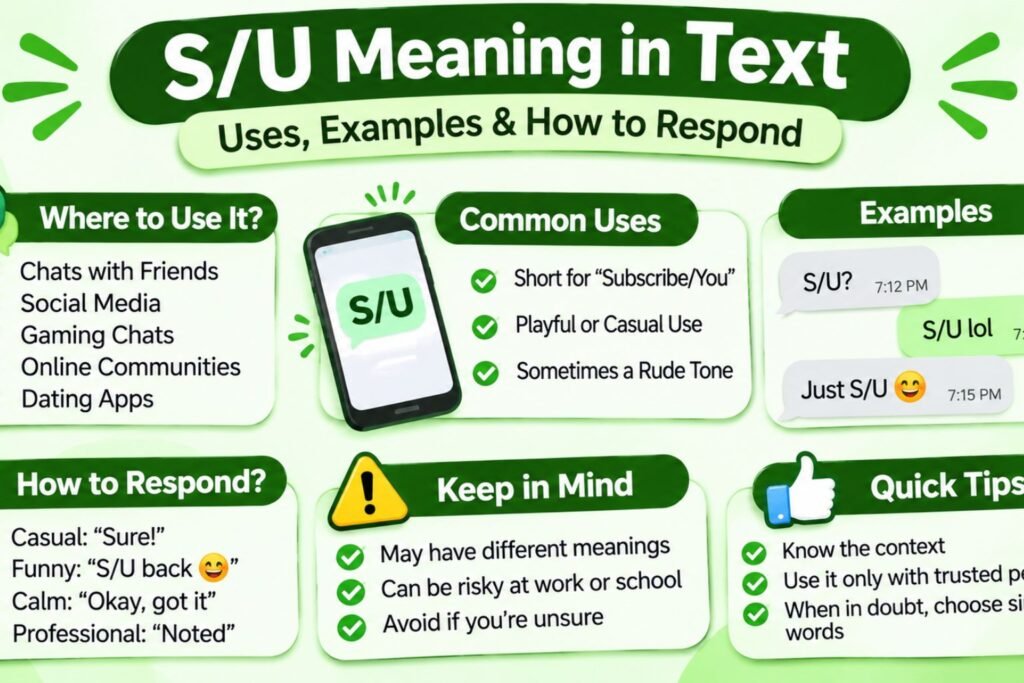
Table of Contents
Conclusion
S/U Meaning In Text is a small shortcut with a flexible meaning. In 2026 chats it usually means “shut up,” but whether it signals teasing, shock, or real anger depends on the context around it. Read the tone, consider who sent it, and ask if you are not sure. Keep it out of professional messages, and remember the academic meaning if you see it in a school setting.
1 thought on “S/U Meaning in Text:What This Shortcut Really Means in Chats, DMs, and Social Media in 2026 ”