

You’ve probably seen “Restaurant Guru” on a Google result, a restaurant window sticker, or a friend’s food recommendation. It can mean a few different things depending on where you see it, and mixing them up leads to wrong expectations about a restaurant. This guide covers what the term means, how the platform works, what its ratings and awards say about a place, and how to use it without being misled.
What Is Restaurant Guru Meaning?
Restaurant Guru is a restaurant search and discovery website, with an app alongside it. It collects information about places to eat and presents it in one place so you can decide where to go. It is not a restaurant, a food critic, or a booking service in the way some other apps are.
What Does Restaurant Guru Mean?
The name combines two ideas. A “guru” is someone with deep knowledge, and the name suggests a one-stop expert on where to eat. In practice, the expertise comes from collected data and community feedback, not from one person tasting every dish.
Restaurant Guru as a Platform
As a platform, it works like a directory. Restaurant Guru aggregates restaurant information from multiple sources, with visitor reviews, menus, photos, opening hours, interactive maps, and search by cuisine, dish, location, or price. It also shows aggregated ratings from sources such as Michelin, Frommer’s, Google, and Facebook.
That aggregation is its main value. You see a restaurant’s menu, photos, and ratings together instead of opening five tabs.
Restaurant Guru as an Ordinary Phrase
People also use “restaurant guru” as a plain phrase, with no capital letters and no website involved. It describes a person who knows food and dining well: the friend everyone asks where to eat, a seasoned food blogger, or an industry veteran. If someone says “my uncle is the family restaurant guru,” they mean he’s the go-to expert, not that he works for a website.
Context tells you which meaning applies. A capitalized name next to a rating or badge points to the platform. A casual sentence about a person points to the general phrase.
How Does Restaurant Guru Work?
You search, narrow the results, read the details, and compare. The process is simple, but each step affects the quality of your decision.
Search for a Restaurant or Location
Start with a city, neighborhood, cuisine, or the name of a place you’ve heard about. Searching by dish also works, which helps if you’re craving something specific, like ramen or paneer tikka, rather than a restaurant type.
Filter the Available Options
Filters narrow a long list quickly. Depending on the page, you can usually sort by cuisine, price range, rating, or what’s near you. Filtering by what you need that night, such as a quiet table, a late kitchen, or a vegetarian-friendly menu, saves more time than scrolling through top-rated lists.
Review Restaurant Information
Each listing generally brings together:
- Opening hours and location on a map
- Menu details and sometimes prices
- Photos from visitors
- Written reviews
- Ratings and any awards displayed
Treat this as a first pass. The listing tells you what a place is like, but it may not tell you what it’s like today.
Compare Your Shortlist
Pick three or four candidates and compare them on what matters to you: distance, price, recent reviews, and menu fit. A restaurant with a 4.4 rating and recent reviews praising the service may beat a 4.7 whose latest reviews mention long waits.
What Do Restaurant Guru Ratings Mean?
A rating is a summary of opinions, not a measurement of quality. It reflects how past visitors felt about their meals, and those visitors had different tastes, budgets, and expectations. A high score usually means many people were satisfied. A low score usually points to a pattern of complaints worth reading about.
As a rule of thumb, the number of reviews matters as much as the score. A 4.8 from twelve reviews is less reliable than a 4.4 from twelve hundred.
Does a High Rating Guarantee Good Food?
No. Several things can separate a high rating from a good meal:
- Taste is personal. Someone who loves spicy food and someone who doesn’t will rate the same dish differently.
- Expectations shape scores. A casual diner might give five stars for a cheap, filling meal, while a fine-dining fan expects far more from a high-priced place.
- Things change. Chefs leave, ownership changes, and standards slip. Older reviews may describe a restaurant that no longer exists in that form.
- Ratings blur the details. A place can have great food and slow service, but a single score hides that.
Read the three or four most recent reviews, including a couple of critical ones. If the complaints are about things you don’t care about, a good score probably applies to you.
What Does a Restaurant Guru Award or Badge Mean?
Restaurants sometimes display a Restaurant Guru award, usually as a sticker, badge, or online graphic. It signals that the platform recognized the restaurant for its performance on the site. Restaurant Guru has stated that its awards are based solely on user reviews. That makes it a signal of customer feedback, not a judgment from professional inspectors.
How to Interpret a Restaurant Guru Award
Think of it as a “customers tend to like this place” marker. It can be a helpful sign, especially for local restaurants that critics rarely cover. But it doesn’t tell you about food technique, ingredient sourcing, or hygiene inspection results, which are things professional guides and health authorities look at.
Use it as one input alongside recent reviews, photos, and the menu.
Can Restaurants Display Restaurant Guru Awards?
Yes, restaurants commonly display them on their websites, social media, and storefronts, as they would with any recognition. Awards also appear on the restaurant’s page on the platform. Some owners are confused by awards or notifications, and a few reviews on the platform’s Trustpilot page show owners reacting with surprise. That confusion usually comes from not realizing how the awards are issued. If you’re a diner, a displayed badge is fine to take at face value as a customer-review signal. If you’re unsure whether a badge is real, check the restaurant’s page on the platform itself.
Is Restaurant Guru Reliable?
It’s reliable as a starting point, and it should be one input in your decision, not the final word. That’s true for nearly every review platform.
What Makes Restaurant Guru Useful?
- Everything in one place. Menus, photos, maps, hours, and ratings appear together.
- Aggregated ratings. Seeing scores from several sources helps you spot consistency or disagreement.
- Search flexibility. Looking up a dish or filtering by price helps when you don’t know the restaurant’s name.
- Coverage. It includes small, local restaurants that guidebooks skip.
What Should You Be Careful About?
- Outdated details. Hours, menus, and prices change. A listing can lag behind reality, and some Trustpilot reviews mention closed or changed businesses still appearing.
- Review quality varies. Some reviews are detailed and fair. Others are one-line reactions or reflect a bad day.
- Ratings can be gamed or skewed. Any open review system can attract exaggerated praise or complaints.
- Awards aren’t inspections. They reflect popularity among reviewers, not professional evaluation.
How to Use Restaurant Guru to Find a Good Restaurant
A repeatable process works better than just sorting by highest score.
Step 1: Decide What Matters Most
Before searching, pick your top two priorities, such as budget, cuisine, dietary needs, distance, atmosphere, or group size. This keeps you from being swayed by a high score at a place that doesn’t fit your evening.
Step 2: Search by Cuisine and Location
Search for your cuisine in your area, or search for a specific dish. If you’re traveling, search by neighborhood so you’re not stuck with a place across town.
Step 3: Compare Recent Reviews
Sort or scan for the newest reviews first. Look for patterns, such as several people mentioning slow service or great vegetarian options. One complaint is an anecdote, but five similar ones are information.
Step 4: Check the Menu and Practical Details
Confirm the menu has something you’ll actually eat, that prices fit your budget, and that the restaurant is open when you plan to arrive. Photos help here, since visitor photos often show portions and presentation better than descriptions.
Step 5: Cross-Check Before Visiting
Spend two minutes checking another source: the restaurant’s own website or social page, or a Google Maps listing. This catches closures, holiday hours, and changed menus. If you’re booking for a special occasion, call ahead.
Restaurant Guru vs. Google Reviews
They overlap, but they do different jobs.
| Restaurant Guru | Google Reviews | |
| What it is | Restaurant-focused directory that aggregates information and ratings from several sources | General maps and local-business platform |
| Strength | Dish and cuisine search, menus, multiple ratings in one place | Large review volume, live hours, directions, and booking links |
| Best for | Exploring options and comparing | Verifying details and getting there |
| Watch out for | Listings that lag behind changes | Review volume varying widely by location |
You don’t need to choose. Use Restaurant Guru to build a shortlist, then use Google Maps to check current hours, recent reviews, and directions. If both show similar ratings, that’s a good sign. If they disagree sharply, read the reviews on each to see why.
Restaurant Guru App: What Can You Do With It?
The app brings the same restaurant discovery tools to your phone. Typically, that means searching by location or cuisine, browsing menus and photos, reading reviews, and checking restaurants near you. The exact features and layout vary by version and device, so check the current description in your app store before relying on a specific feature.
Mobile is most useful when you’re out and deciding quickly, whether that’s a nearby lunch or a late dinner while traveling.
What Does Restaurant Guru Mean for Restaurant Owners?
For owners, a listing on the platform is a form of free visibility. Diners searching by cuisine or area may find you without ever having heard of you.
Why a Restaurant Listing Matters
Many diners decide where to eat using a quick phone search. An accurate listing with good photos, correct hours, and a current menu makes you easier to choose. An incorrect listing, such as wrong hours or a closed location shown as open, can cost you customers and produce frustrated reviews. Owners have posted on Trustpilot about outdated information from previous owners affecting their listing and about getting it corrected by the platform’s team.
Can a Restaurant Owner Improve Its Listing?
Owners can generally take practical steps to improve how they appear:
- Check the details. Confirm your name, address, phone number, hours, and menu are correct.
- Contact the platform. If information is wrong or outdated, use their support channel to request a correction or to get access to manage your page.
- Encourage honest reviews. Ask happy customers to leave feedback, and don’t pay for or fake reviews.
- Respond professionally. Calm, specific replies to criticism show future customers how you handle problems.
- Keep photos current. Good visuals of your food and space help diners decide.
Processes for claiming or editing a listing can change, so follow the platform’s current instructions.
Common Misunderstandings About Restaurant Guru
Restaurant Guru Is Not a Restaurant Itself
Despite the name, it doesn’t cook, serve, or deliver food. It lists restaurants. One Trustpilot reviewer was upset after a customer ordered through a site they confused with this platform, which shows how a similar-sounding name can create confusion. If you place an order, check who is actually fulfilling it.
A Restaurant Guru Award Is Not Automatically a Michelin Star
The two are different things. A Michelin recognition comes from a professional guide’s process. A Restaurant Guru award reflects user reviews on the platform. Both can be meaningful, but they measure different things, so don’t treat them as equivalent.
A High Score Does Not Guarantee a Perfect Visit
Even excellent restaurants have off nights, staffing problems, and long waits. A score tells you the odds are good, not that your visit is guaranteed.
Every Listing Detail May Not Be Current
Menus, prices, and hours change faster than listings do. When something matters, such as a reservation or a dietary requirement, confirm it directly with the restaurant.
The Phrase Can Have a General Meaning
As covered earlier, “restaurant guru” can simply mean a person who knows dining well. Don’t assume every mention refers to the website.
Frequently Asked Questions
What is Restaurant Guru meaning in simple words?
It’s a website and app for finding restaurants. You search by place, cuisine, or dish, and it shows menus, photos, reviews, ratings, and locations in one place.
What does Restaurant Guru mean in English?
Literally, it means an expert on restaurants. As a name, it refers to the restaurant discovery platform. As a lowercase phrase, it describes anyone with deep knowledge of dining.
Is Restaurant Guru a free website?
It’s generally free for diners to browse and search. Features and any options for businesses can change, so check the site directly for current details.
Are Restaurant Guru ratings accurate?
They’re a reasonable guide to general opinion, not a precise measure of quality. Accuracy depends on the number and recency of reviews. Check recent reviews and compare with another source, like Google Maps, before deciding.
What does a Restaurant Guru award mean?
It’s a recognition based on user reviews, according to the platform. It signals customer approval, not a professional inspection or critic’s verdict.
How does Restaurant Guru choose restaurants to recommend?
The platform aggregates information and ratings from several sources, and its awards rely on user reviews. It hasn’t published every detail of its ranking process that I could verify, so treat recommendations as a starting point and check the reviews yourself.
Is Restaurant Guru better than Google Reviews?
Neither is strictly better. Restaurant Guru is stronger for browsing and comparing restaurants in one place, while Google is stronger for live details and directions. Using both gives the best picture.
Can restaurant owners use Restaurant Guru?
Yes. Owners can check their listing, request corrections, and manage how their restaurant appears, following the platform’s current process. Contact their support team if details are wrong.
Does Restaurant Guru have a mobile app?
Yes, it offers an app. Check your device’s app store for the current version and features.
Final Thoughts
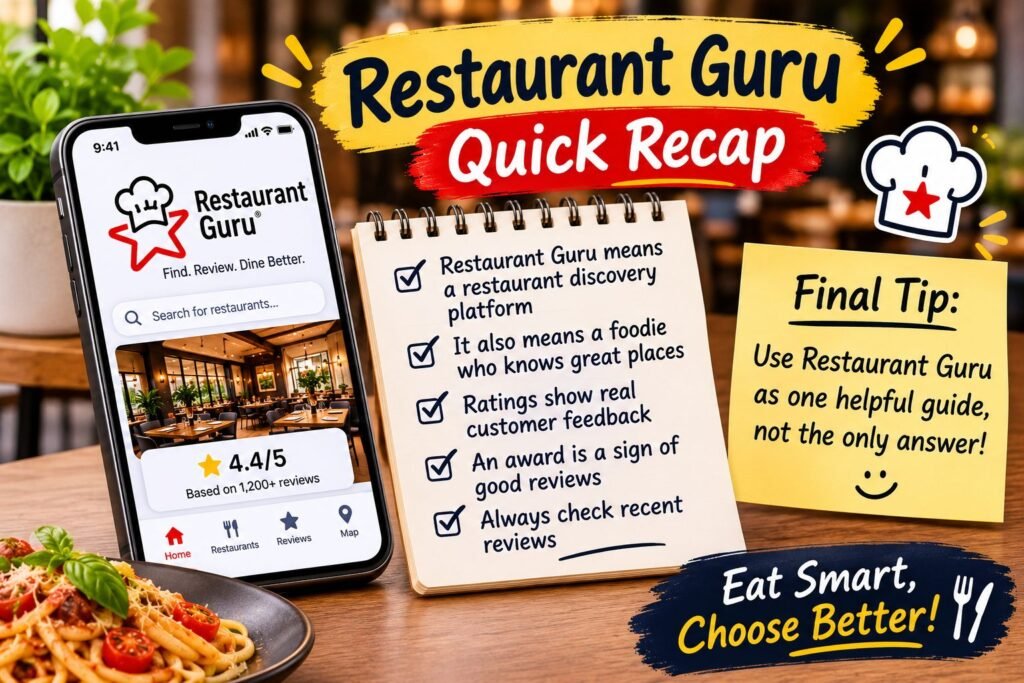
Restaurant Guru is best understood as a convenient restaurant directory with community-driven ratings and awards, not a verdict on quality. Use it to build a shortlist, read recent reviews with a critical eye, and confirm key details before you go. Used that way, it takes the guesswork out of choosing where to eat.
2 thoughts on “Restaurant Guru Meaning | Decode the Foodie Term and Discover What It Really Says About Dining in 2026 ”