
Etail is the word for selling products to customers over the internet. If you have ever ordered shoes from a website, bought a phone case on a marketplace app, or signed up for a monthly snack box, you have taken part in etailing, whether or not you knew the term.
The word sounds technical, but the idea is simple. This guide explains what etail means, how it differs from e-commerce and traditional retail, how an online order moves from a click to your doorstep, and what it takes to start an etail business in 2026. It also clears up the most common misunderstandings, because many articles use “etail,” “e-commerce,” and “online store” as if they were one thing.
What Does Etail Meaning in Simple English?
Etail means retail that happens online. A business lists products on a website, app, or online platform, and customers browse, choose, pay, and receive the goods without visiting a physical shop.
The word is a blend of “electronic” and “retail.” The “e” works the same way it does in email or e-book: it signals that something familiar now happens through digital channels. The seller who runs the operation is called an etailer, and the activity is called etailing or e-tailing.
A quick example: a small brand that sells handmade candles through its own website is an etailer. So is a giant marketplace that sells millions of products from thousands of sellers. The scale differs, but the core idea is the same. The product is sold to a customer through an online channel.
Is Etail a Real Word?
Yes. Etail is a real, established business term, and you will find it in major dictionaries and in trade publications covering the retail industry. It became popular in the late 1990s, when the first wave of online stores appeared, and it has stayed in use ever since.
It is not a formal academic term, though, and it is less common in everyday conversation than “online shopping.” You will see it most often in business news, retail reports, marketing articles, and discussions of industry trends. Spelling varies too. “Etail,” “e-tail,” and “eTail” are all seen, and “e-tailer” and “etailer” are used interchangeably. Pick one style for your own writing and keep it consistent.
What Is the Difference Between Etail and E-Commerce?
This is the question people ask most, and the answer is about scope.
E-commerce is the broad category. It covers any buying and selling of goods or services over the internet. That includes a shopper buying a jacket, a company buying bulk supplies from a wholesaler, someone booking a flight, a student paying for an online course, and a person reselling a used bike on a classifieds site.
Etail is one slice of it: the retail slice. It refers specifically to businesses selling products to end consumers online.
So every etail transaction is an e-commerce transaction, but not every e-commerce transaction is etail. A company buying 500 office chairs from a supplier through an online portal is doing e-commerce, but it is not etailing because it is not a consumer retail sale.
Etail vs. E-Commerce: Comparison Table
| Feature | Etail | E-Commerce |
| Scope | Narrower; online retail only | Broader; all online commercial activity |
| Typical buyer | Individual consumers | Consumers, businesses, and organizations |
| What is sold | Mostly products | Products, services, subscriptions, bookings, digital goods |
| Example | A clothing brand selling to shoppers on its website | A flight booking, a B2B supply order, an online course, a retail sale |
| Relationship | A subset of e-commerce | The umbrella category |
In everyday use, people mix the two terms constantly, and in casual conversation that is usually fine. When precision matters, such as in a business plan, a report, or an SEO page, it helps to know which one you mean.
Etail vs. Traditional Retail
Traditional retail means selling goods through physical locations: supermarkets, boutiques, department stores, pharmacies, and corner shops. Customers walk in, handle the product, and usually take it home the same day.
Etail moves that whole experience onto a screen. The shelf becomes a product page, the shop assistant becomes a chat window or FAQ, and the checkout counter becomes a payment form.
Key Differences Between Etail and Retail
- Location: Physical stores need a place, and the location shapes who can shop there. Etailers can reach customers anywhere they can deliver.
- Opening hours: A shop closes at night. An online store takes orders around the clock.
- Product experience: In-store shoppers can touch, try on, and test items. Online shoppers rely on photos, descriptions, size guides, videos, and reviews.
- Speed of getting the product: A store sale is instant. An online order has to be packed and shipped, even when delivery is fast.
- Cost structure: Stores carry rent, fit-out, and in-store staff. Etailers carry website and platform costs, advertising, packaging, shipping, and returns handling.
- Customer data: Online sellers can see what people searched, clicked, abandoned, and bought. Physical stores have to work harder to collect similar insight.
- Returns: Returning something to a shop is usually quick. Online returns involve shipping the item back and processing a refund, which costs time and money.
Neither model is simply better. Each solves different problems, and plenty of shoppers use both depending on what they are buying.
Can a Business Use Both Models?
Absolutely, and many of the most successful retailers do. This approach is often called omnichannel retail, where physical stores, websites, and apps work together as one experience.
Common examples include buying online and picking up in store, checking local stock before visiting, returning online orders at a shop, or using the store as a showroom while the website handles the order. A bakery with one storefront that also ships gift boxes nationwide is using both models. So is a furniture chain with showrooms and an online catalog.
The reason it works is simple: customers do not think in channels. They think in convenience. Businesses that let people choose how they shop usually keep more of them.
Real-World Examples of Etail
Etail is not one single format. It shows up in several forms, and seeing them side by side makes the concept easier to grasp.
Online Marketplaces
A marketplace is a platform where many independent sellers list products in one place, and the platform handles discovery, payments, and often parts of the logistics. Amazon, eBay, Etsy, Walmart Marketplace, and Flipkart are well-known examples. In Southeast Asia, Shopee and Lazada work the same way.
Marketplaces give sellers instant access to a large audience, but sellers pay fees and compete directly with similar products on the same page.
Brand-Owned Online Stores
Here the brand sells directly through its own website. Think of a sportswear company with its own online shop, or a skincare label that only sells through its site. The brand controls pricing, presentation, customer data, and the overall experience.
The trade-off is that the brand must bring in its own traffic. Nobody arrives automatically the way they do on a marketplace.
Small Business Websites
Many etailers are simply small businesses with a modest site built on a platform like Shopify, WooCommerce, Wix, or Squarespace. A local tea blender, a jewelry maker, or a pet-supplies shop selling nationwide all fit here.
These businesses often succeed by focusing on a niche, a story, or a level of service larger sellers cannot match.
Social Commerce Stores
Social commerce lets customers discover and buy products inside social platforms, such as Instagram Shops, Facebook Shops, and TikTok Shop. Purchases can happen with very little friction, sometimes right from a video or live stream.
This model works best for visual, impulse-friendly, or trend-driven products, and it relies heavily on content and community.
Subscription-Based Product Stores
Subscription etailers deliver products on a recurring schedule, such as coffee, razors, vitamins, pet food, or beauty boxes. The customer signs up once and receives orders automatically.
The appeal for the seller is predictable revenue. The appeal for the buyer is not having to remember to reorder.
Digital Product Stores
Not everything sold online is physical. E-books, software, templates, stock photos, music, fonts, and online courses are all sold through digital storefronts. There is no shipping, and delivery happens by download or access link.
One note on terminology: some people would call this e-commerce rather than classic etail, since the word “retail” traditionally implies tangible goods. In practice, the two terms overlap, and many people count digital storefronts as etail.
How Does Etailing Work?
Behind a simple “Buy now” button is a chain of steps. Understanding it helps both shoppers and anyone planning to sell online.
Step 1: Products Are Listed Online
The etailer creates product pages with titles, photos, descriptions, prices, sizes or variants, and stock information. Good listings do the job a shop assistant would do: they answer the questions a customer would ask out loud.
Step 2: Customers Discover and Compare Products
Shoppers find products through search engines, marketplace searches, social media, ads, email, or recommendations from friends. They compare prices, read reviews, check delivery times, and look at return policies before deciding.
Step 3: Customers Add Products to Their Cart
When something looks right, the customer adds it to a cart. This is where many sales are lost. Shoppers often add items to a cart and leave without buying, which is why etailers pay close attention to clear pricing and a simple checkout.
Step 4: The Order Is Placed and Payment Is Processed
At checkout, the customer enters shipping details and pays by card, digital wallet, bank transfer, buy-now-pay-later, or cash on delivery, depending on the market. A payment gateway securely handles the transaction and confirms it with the bank or card network.
Step 5: Inventory Is Checked
Once the order goes through, the system confirms the item is actually in stock and reserves it. Good inventory management stops the embarrassing situation where a customer pays for something that no longer exists. Sellers using several channels at once need their stock counts to sync across them.
Step 6: The Order Is Packed and Shipped
Staff, or a third-party fulfillment partner, pick the item, pack it, print a shipping label, and hand it to a courier. Some etailers fulfill orders themselves, some use warehouses, and some use dropshipping, where a supplier ships directly to the customer.
Step 7: The Customer Receives the Order
The package travels through the courier network, and the customer usually receives tracking updates along the way. Delivery speed, packaging quality, and accuracy all shape how the customer feels about the purchase. Even great products can leave a bad impression if they arrive late or damaged.
Step 8: Customer Support and Repeat Purchases
After delivery, the relationship continues. The customer may need help with sizing, a return, a refund, or a warranty claim. Businesses that handle these moments well turn first-time buyers into repeat customers through follow-up emails, loyalty programs, or reorder reminders.
Main Types of Etail Business Models
Etail businesses are usually grouped by who is selling to whom.
Business-to-Consumer (B2C)
A business sells directly to individual shoppers. This is the model most people think of when they hear “online store,” and it is the core of etail. A bookstore selling to readers or an electronics seller serving shoppers are both B2C.
Business-to-Business (B2B)
A business sells to other businesses, such as a wholesaler supplying cafés with coffee beans or a supplier selling packaging materials. B2B orders tend to be larger, may involve negotiated pricing, and often use account-based ordering.
Strictly speaking, B2B online selling falls under e-commerce rather than consumer etail, but many sellers operate both models side by side.
Consumer-to-Consumer (C2C)
Individuals sell to other individuals through a platform. Resale marketplaces, classifieds sites, and secondhand fashion apps are typical examples. The platform provides the meeting place and usually takes a fee or commission.
Direct-to-Consumer (D2C)
A brand that makes its own products sells straight to customers and skips wholesalers and retailers. D2C brands keep more control over branding, pricing, and customer relationships, and they own their customer data. The cost is that they handle marketing, fulfillment, and support themselves.
Marketplace-Based Etailing
Here sellers list products on someone else’s platform. It lowers the barrier to entry because the audience and payment tools already exist. The downsides are marketplace fees, rules that can change, and heavy competition on every product page.
Subscription Etailing
Customers pay regularly to receive products automatically, whether weekly, monthly, or quarterly. It works well for consumables and curated boxes, where repeat purchase is natural.
What Are the Advantages of Etailing?
Convenience for Customers
Shoppers can browse and buy at any hour, from any place, without traveling or queuing. For people with limited mobility, busy schedules, or no nearby stores, that convenience is the main reason online buying exists.
Wider Geographic Reach
A physical shop mostly serves the people who can reach it. An online store can serve customers across a city, a country, or the world, as long as delivery is possible. This changes the economics for niche products, because a small number of interested buyers in each place adds up.
A Broader Product Selection
Without shelf-space limits, etailers can offer far more variety than a typical shop floor can hold: more sizes, colors, brands, and specialty items. Shoppers can find things that local stores simply do not stock.
Easier Product Comparison
Prices, specifications, reviews, and delivery options are a few clicks apart. That transparency benefits buyers, and it pushes sellers to compete on value, service, and trust rather than on location alone.
Access to Customer Feedback
Reviews, ratings, questions, and return reasons give etailers a steady stream of information. A seller who reads them carefully can spot weak products, unclear descriptions, and sizing problems quickly.
Opportunities for Small Businesses
Launching an online store usually costs far less than leasing a shop. A single person with a laptop, a good product, and decent photos can reach real customers. That does not make success easy, but it does make the starting line far more accessible.
Useful Sales and Inventory Data
Online sellers can track which products sell, which pages convert, where visitors drop off, and which campaigns bring buyers. With that information they can adjust pricing, stock, and marketing based on evidence rather than guesswork.
What Are the Disadvantages of Etailing?
Customers Cannot Always Inspect Products in Person
Shoppers cannot feel fabric, test comfort, or judge true color on a screen. That uncertainty is a major reason for hesitation and returns, especially in clothing, furniture, and beauty products. Detailed descriptions, size charts, close-up photos, and customer photos reduce the gap but do not remove it.
Shipping and Delivery Costs
Delivery is rarely free for the seller, even when it looks free to the customer. Fuel, packaging, courier fees, and handling all add up, and customers have come to expect speed. Heavy, fragile, or low-priced items can be especially hard to ship profitably.
High Competition
Starting is easy, so many people start. Sellers compete not just with local businesses but with marketplaces and brands worldwide. Without a clear niche or point of difference, price becomes the only way to stand out, and that is a hard game to win.
Dependence on Technology
An etail business relies on its website, payment systems, hosting, and logistics software. Outages, security problems, or platform changes can interrupt sales immediately. Sellers who depend on a single marketplace or ad platform are especially exposed if the rules or costs change.
Returns and Refunds
Online purchases are returned more often than store purchases, mostly because buyers cannot check items beforehand. Every return costs shipping, handling, and sometimes resale value. A clear policy and accurate product information are the best ways to keep returns under control.
Building Customer Trust
A shopper who has never heard of you has to hand over payment details to a stranger. Trust signals matter: clear contact information, honest reviews, secure checkout, transparent policies, and reliable delivery. A single bad experience can undo a lot of goodwill, and trust takes time to earn.
How to Start an Etail Business
Starting small and being specific beats trying to launch everything at once. Here is a practical sequence.
1. Choose a Specific Product Category
“Everything for everyone” is hard to market. Focus on a defined category such as eco-friendly kitchenware, plus-size workwear, or specialty teas. A specific focus makes your messaging clearer and your competition easier to understand.
2. Research Your Target Customers
Work out who buys this type of product, what problems they want solved, and where they shop today. Read reviews of competing products to see what customers love and what frustrates them. Those complaints are often your opportunity.
3. Choose a Sales Channel
You can sell through your own website, a marketplace, social platforms, or a mix. Marketplaces bring ready-made traffic but take fees and limit branding. Your own site gives control but requires you to attract visitors. Many sellers begin on one channel and expand gradually.
4. Calculate the True Cost of Each Sale
Many new sellers look only at product cost and selling price. Include platform or payment fees, shipping, packaging, advertising, returns, and any software subscriptions. Only then do you know your real margin per order, and whether the business model works.
5. Create Accurate Product Listings
Use clear photos from several angles, honest descriptions, correct dimensions, and complete details such as materials, care instructions, and sizing. Accurate listings improve conversion and cut returns. Write for the customer’s questions, not just for search engines.
6. Set Up Payments and Order Fulfillment
Choose reliable payment methods that your customers actually use in your market, and decide how orders will be fulfilled: from home, from a small stockroom, through a fulfillment service, or via dropshipping. Test the whole process with a few practice orders before launch.
7. Create Clear Customer Policies
Publish plain-language policies on shipping times, costs, returns, refunds, and privacy. Clear rules reduce disputes and build confidence. Make them easy to find, not buried in fine print.
8. Measure Results and Improve
Track traffic, conversion rate, average order value, return rate, and repeat purchases. Look at what works, fix what does not, and change one thing at a time so you can tell what made the difference. Etail rewards steady improvement more than big launches.
How Is Etail Different From an Online Store?
An online store is a specific thing: a website or app where products are sold. Etail is the broader activity and business model of retailing online.
Put simply, the online store is the tool, and etail is what the business does with it. An etailer might operate its own online store, sell through marketplaces, run social shops, and manage fulfillment and customer service. The store is one part of the whole.
That is also why a seller can be an etailer without having a company-owned website. A person who sells only through a marketplace storefront is still practicing etail.
Common Misunderstandings About Etail
Mistake 1: Treating Etail and E-Commerce as Identical
They are related but not the same. E-commerce is the larger umbrella covering all online commercial transactions, including services and B2B deals. Etail is the consumer-retail portion. In casual speech the difference rarely matters. In business planning, reporting, or content, it can.
Mistake 2: Assuming Etail Requires a Company-Owned Website
It does not. Selling through a marketplace, a social shop, or another platform still counts. A website is one option, not a requirement. Many sellers start on a marketplace and add their own site later.
Mistake 3: Thinking Etail Always Means Selling Physical Goods
Traditional retail meant physical products, and most etail still does. But digital products such as e-books, templates, and software are sold through online storefronts as well. Whether you label that etail or broader e-commerce is partly a matter of preference, which is why the boundary can feel fuzzy.
Mistake 4: Assuming Every Online Seller Is a Retailer
Not every online seller fits the retail definition. A manufacturer selling in bulk to other companies, an individual clearing out used items, and a service provider selling bookings are all online sellers, but they are not all retailers in the strict sense. Retail means selling goods to end consumers, usually as a business.
Mistake 5: Assuming Online Retail Has No Major Operating Costs
“No rent” does not mean “no costs.” Etailers pay for advertising, platform and payment fees, shipping, packaging, software, customer service, and returns. Some of these can exceed what a small shop would pay in rent. Treating online selling as automatically cheap is one of the most common reasons new stores struggle.
Frequently Asked Questions
What is the etail meaning in simple words?
Etail means selling products to customers online instead of in a physical shop. It is short for “electronic retail.”
What does e-tail stand for?
E-tail stands for “electronic retail.” The “e” stands for electronic, in the same way it does in email or e-commerce, and “tail” comes from the word retail.
What is the difference between etail and e-commerce?
E-commerce covers all buying and selling online, including services, B2B sales, and digital products. Etail is the narrower part focused on retailers selling products to consumers. All etail is e-commerce, but not all e-commerce is etail.
What is an etailer?
An etailer is a business that sells products to consumers online. It can be a global marketplace, a brand with its own website, or a small seller running a niche online shop.
What is e-tailing with an example?
E-tailing is the act of selling retail goods online. For example, a running-shoe brand that takes orders through its website and ships them to customers is e-tailing. So is an independent seller listing handmade soap on a marketplace.
Is Amazon an example of etail?
Yes. Amazon is one of the best-known examples. It operates as an online retailer selling products directly, and it also runs a marketplace where third-party sellers list their own goods. Both activities fall under etail.
Is etail the same as online shopping?
They describe the same activity from different sides. Online shopping is what the customer does, and etail is what the seller does and the industry it creates. In everyday conversation, people often use them loosely as equivalents.
What are the main advantages of etailing?
The main advantages are customer convenience, a wider geographic reach, broader product selection, easy comparison, useful customer feedback, a lower barrier for small businesses, and access to detailed sales and inventory data.
Can a small business start an etail store?
Yes. Small businesses often start with a simple website builder or a marketplace storefront, a focused product range, and careful cost tracking. Success depends less on size than on product choice, accurate listings, reliable delivery, and clear customer policies.
How do you pronounce etail?
Etail is pronounced “EE-tayl.” The first syllable sounds like the “e” in email, and the second rhymes with “retail” without the “re.”
Final Thoughts
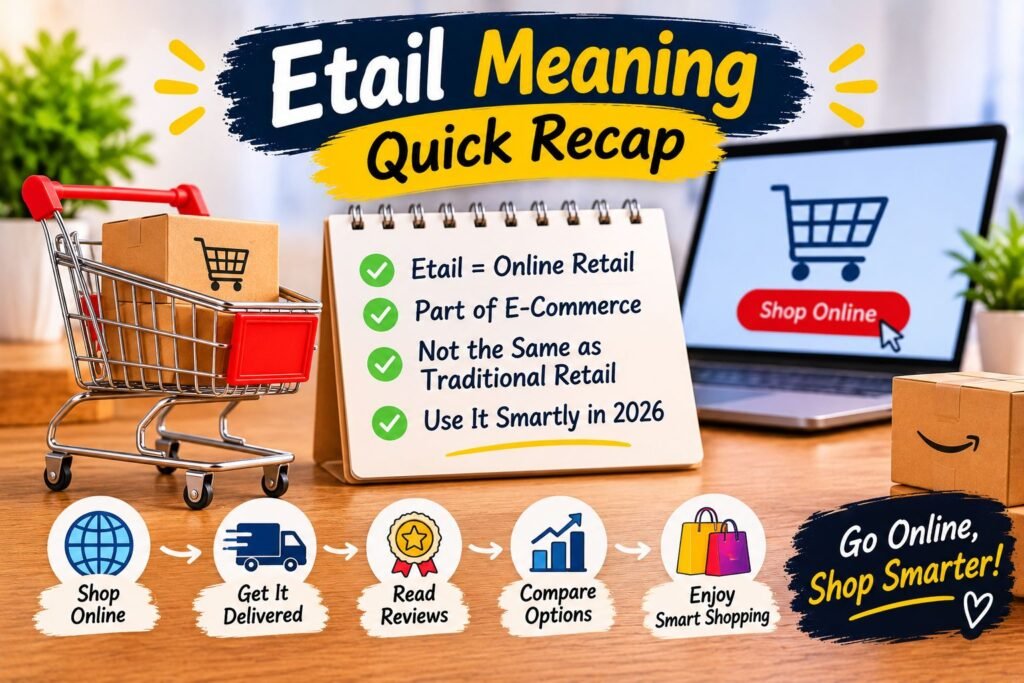
Etail is simply retail carried out online: products listed, found, bought, and delivered without a customer stepping into a shop. It sits inside the wider world of e-commerce, takes many forms, from marketplaces to social shops to subscription boxes, and works alongside traditional retail rather than replacing it.
If you are a shopper, understanding etail helps you read the market more clearly. If you are thinking of selling, the lesson is practical: choose a focused niche, know your true costs, describe your products honestly, and treat trust and delivery as seriously as the product itself. The label may be old, but the fundamentals of earning customers’ confidence have not changed.
1 thought on “Etail Meaning | The Digital Shopping Revolution, Real-World Examples, and How Online Retail Works in 2026 ”