

If you’ve just received a message with “FQ” in it and no idea what it means, you’re in good company. Unlike LOL, BRB, or IDK, FQ has no single, universally accepted meaning in text messages. What it means depends on who sent it, the platform, and the sentence around it. This guide covers the possible meanings, how to tell them apart, and how to reply without making things awkward.
FQ Slang– Quick Meaning
Here is the short version:
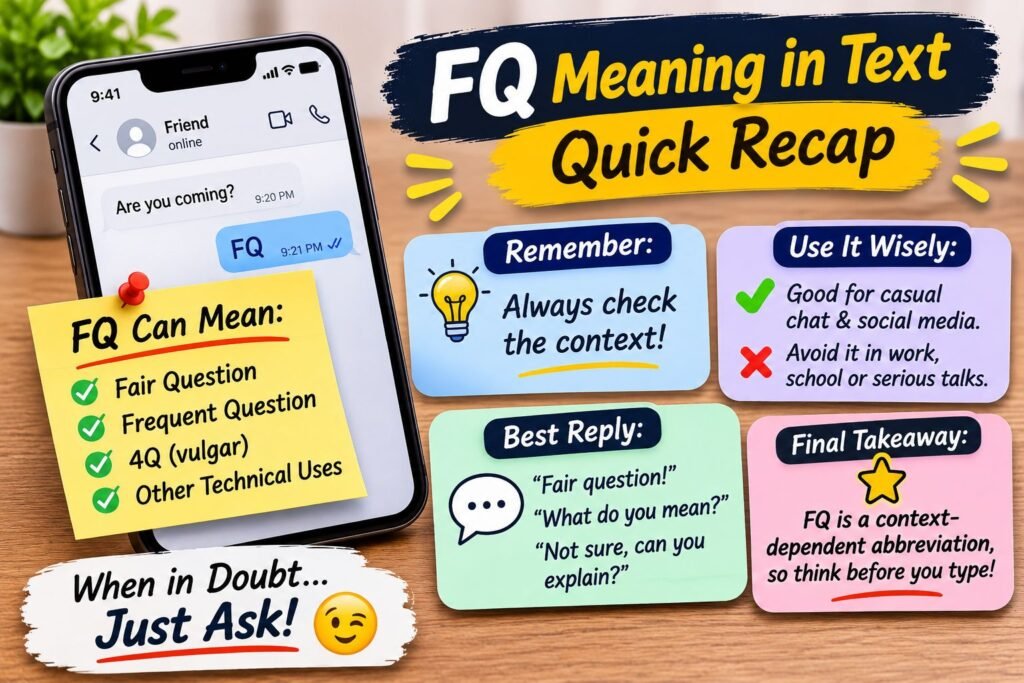
- Most likely, in casual chat: a shorthand for “fair question” or “frequent question,” used by some people but not widely standardized.
- Possible vulgar reading: a variant of “4Q,” which slang references list as a rude way of saying “f*** you.” The “4” imitates the sound of the swear word and “Q” stands in for “you.”
- Outside texting: FQ can stand for things like a “quotient” (as in fitness or financial quotient) or appear in technical and regional contexts.
If a message is unclear, treat it as unconfirmed and ask. Guessing wrong can turn a harmless message into an argument.
Fq meaning in text-Origin & Background
FQ abbreviation never developed the way LOL or OMG did, so there is no clear origin story, and anyone claiming one should be treated with caution. Several unrelated threads explain why it shows up:
- Typing shorthand. People abbreviate phrases (“fair question,” “frequent question”) on the fly, and some of these stick only within friend groups.
- Phonetic slang. Numbers and letters often stand in for sounds in text slang, which is how “4Q” came about. The “F” and “4” are easy to mix up when typing quickly.
- Other fields. Abbreviation databases note that FQ has multiple meanings, including educational, medical, and computer terms, so it can be ambiguous. In geography, FQ was an ISO country code for the French Southern Territories between 1974 and 1979.
- Chinese internet culture. As far as I know, “FQ” is also used as a pinyin shorthand for 愤青 (fènqīng), often translated as “angry youth,” a term for someone seen as overly passionate or nationalistic. A language-learning source on Chinese internet slang lists FQ alongside 愤青 (fèn qīng) as an example of alphanumeric slang.
The takeaway: FQ meaning is a context-dependent abbreviation, not a settled slang term.
Real-Life Conversations
These are illustrative examples showing how FQ meaning could appear, not recorded chats.
1. WhatsApp Conversation
Ravi: Wait, are you actually quitting your job?
Mia: FQ 😅 honestly I’m still deciding.
Here FQ most plausibly means “fair question.” The tone is light and Mia answers directly.
2. Instagram DM
Sam: you ghosted me for three days
Jess: FQ
Without more context, this is ambiguous. It could be a short “fair question,” or a clumsy “4Q.” The relationship and tone matter. If Jess seems annoyed, a hostile reading is possible.
3. TikTok Comments
User1: Why does everyone ask about the song?
User2: FQ of the week 😂
In public comments, FQ can be a playful nod to a “frequent question” that keeps coming up, a bit like a mini-FAQ.
4. Text Message
Dad: FQ: what time does the train leave?
Some people use “FQ:” as a label for a question, the way others write “Q:”. It is informal and personal, and not everyone will get it.
Emotional & Psychological Meaning
The emotional weight of FQ slang depends almost entirely on tone:
- As “fair question,” it acknowledges the other person’s point without escalating. It can signal openness or mild humor.
- As “4Q,” it is a deliberate insult and signals anger, contempt, or sarcasm.
- As a label (frequent question), it is neutral and informational.
Short abbreviations can feel colder than full sentences because they strip out vocal tone. A reply that would sound friendly out loud can read as dismissive in text, which is why it’s worth checking intent before reacting.
Usage in Different Contexts
Social Media
On platforms like TikTok, Instagram, and X, Fq abbreviations spread through repetition and in-jokes. FQ is not widespread enough to carry a standard meaning there, so comment-section usage is usually playful and loosely defined.
Friends & Relationships
Among close friends, FQ slang might be a private shorthand. In a relationship, though, unclear abbreviations during a disagreement can cause misreadings. If you’re unsure, ask directly.
Work & Professional Settings
Avoid FQ at work. Colleagues, clients, and managers may not know it, and the vulgar reading could be assumed. Write out “good question” or “fair point” instead.
Casual vs. Serious Tone
In casual banter, a light “FQ” is probably harmless. In serious conversations such as conflicts, apologies, or complaints, spell things out. Ambiguity is the last thing you want.
When NOT to Use FQ
- In any professional or academic message
- With people older or less familiar with internet slang
- During arguments or emotional conversations
- With anyone you have just met
- When you could be mistaken for saying something rude
If a shorter phrase is what you want, “fair question” is only two words and always clear.
Common Misunderstandings
1. Assuming FQ Always Means “Fair Question”
That is one plausible reading, not a rule. Check the surrounding message.
2. Confusing FQ With FAQ
FAQ means “Frequently Asked Questions” and is a standard, widely recognized term, usually found on websites. FQ is not an official shortened form of it.
3. Thinking It Is a Universal Slang Term
Some low-quality sites state confidently that FQ means one specific thing. Reliable references do not show a single agreed meaning. One site that does claim “Frequently Asked” admits FQ is not universally recognized and depends on context.
4. Ignoring Tone
A friendly emoji and a sneering one change the meaning completely. Always read FQ alongside tone, punctuation, and the history of the conversation.
5. Assuming Literal Meaning
Slang is playful. Even if FQ stands for “fair question,” the sender might be joking, deflecting, or being sarcastic.
Comparison Table
| Possible meaning | Where you might see it | Tone | How confident can you be? |
| Fair question | Friend chats, DMs | Light, friendly | Plausible, not standardized |
| Frequent question | Comments, group chats, labels | Neutral | Plausible, not standardized |
| 4Q (a vulgar “f*** you”) | Heated or sarcastic messages | Hostile | Documented for “4Q,” possible if “FQ” is a typo or variant |
| 愤青 (fènqīng, “angry youth”) | Chinese-language online spaces | Mildly critical | Context-specific |
| Quotient (fitness, financial, etc.) | Articles, quizzes, apps | Neutral | Not texting slang |
| ISO country code (historical) | Geography data | Neutral | Not texting slang |
Key Insight
There is no single “real” meaning. The sender’s intent and your shared context are the only reliable guides, and asking beats guessing.
How to Respond When Someone Uses FQ
Casual Replies
- “Haha, what does FQ mean here?”
- “Wait, FQ as in fair question?”
Funny Replies
- “FQ? Is that a new Olympic sport?”
- “I need a dictionary for this chat 😂”
Mature Replies
- “I’m not sure I understand FQ. Could you clarify?”
- “Can you spell that out so I don’t misread it?”
Respectful Replies
- “I want to make sure I understand you correctly. What did you mean by FQ?”
- “Thanks for the message. I wasn’t familiar with FQ, so could you explain?”
If the message felt hostile, stay calm. Asking “Did you mean that as an insult?” is fair, and you can step away if things escalate.
Regional & Cultural Usage
Western Culture
In English-speaking countries, FQ is rare. Most readers would guess “fair question” or a typo, and some would think of “4Q.”
Asian Culture
In Chinese internet contexts, FQ can point to 愤青 (fènqīng, “angry youth”), as noted above. Because I can’t verify how widespread this is across all platforms, treat it as context-specific. Pinyin initials like this are a common pattern in Chinese online slang.
Middle Eastern Culture
I could not find reliable evidence of a distinct, established meaning for FQ in Arabic, Persian, or Hebrew-speaking online communities. Messages there may simply use it as an English-letter abbreviation or typo.
Global Internet Usage
Globally, FQ is a niche abbreviation with no unified meaning. Expect different interpretations depending on language, community, and platform.
Gen Z vs. Millennials
Gen Z tends to invent and drop slang quickly, often within small friend groups, so an FQ in a Gen Z chat may just be a private in-joke. Millennials are more likely to read it as a typo or to ask for clarification. Neither generation has made FQ mainstream, so don’t assume your age group “should” know it.
Is It Safe for Kids?
The abbreviation itself is not inherently harmful, but because it can be read as a variant of a vulgar insult (4Q), parents may want to ask their children what they or their friends mean when they use it. A calm, curious conversation works better than a ban. For kids, the clearest advice is: if you don’t know what a term means, don’t use it, and ask someone you trust.
Frequently Asked Question’s
What does FQ mean in text?
There is no official meaning. It is most plausibly “fair question” or “frequent question” in casual chats, but context decides.
Does FQ mean “fair question”?
Sometimes, among some people. It is not a standardized reading.
Does FQ mean “frequent question”?
Occasionally, as a label for a recurring question. Some sites say this is the common meaning, but they also admit it isn’t universally recognized.
Is FQ the same as FAQ?
No. FAQ is a standard term for “Frequently Asked Questions.” FQ is not an official variant.
Is FQ a common texting abbreviation?
No. It is rare compared with abbreviations like LOL or BRB.
Can FQ have an offensive meaning?
Possibly. The similar abbreviation “4Q” is listed as vulgar slang for “f*** you,” and FQ may be read that way if typed in an angry or sarcastic context. FQ can also be a mildly critical term in some Chinese internet contexts.
What should I do if I don’t understand FQ?
Ask the sender. A quick “What does FQ mean?” avoids misunderstanding and sounds perfectly normal.
Conclusion
The honest answer to “what does FQ mean in text?” is that it depends. It might be a friendly “fair question,” a casual “frequent question,” a vulgar “4Q” lookalike, or something from a completely different field. Since no single definition is widely accepted, the safest approach is simple: read the tone, consider the relationship, and ask if you’re unsure. When you’re the one sending it, write the full phrase and your message will never be misunderstood.
1 thought on “What does FQ Meaning in Text? Real Meaning, Examples & Context (2026) ”