
“Pros and cons” is one of the most useful phrases in English. It is also one of the most overused. Once you have typed it into a third report, essay, or product review, it starts to feel flat. The good news is that English has plenty of alternatives. The better news is that each one carries a slightly different shade of meaning, so choosing well makes your writing more precise, not just more varied.
This guide covers the best synonyms for pros and cons, when each one fits, and how to avoid the mistakes that make a swapped-in phrase sound wrong.
Best Synonyms for Pros and Cons
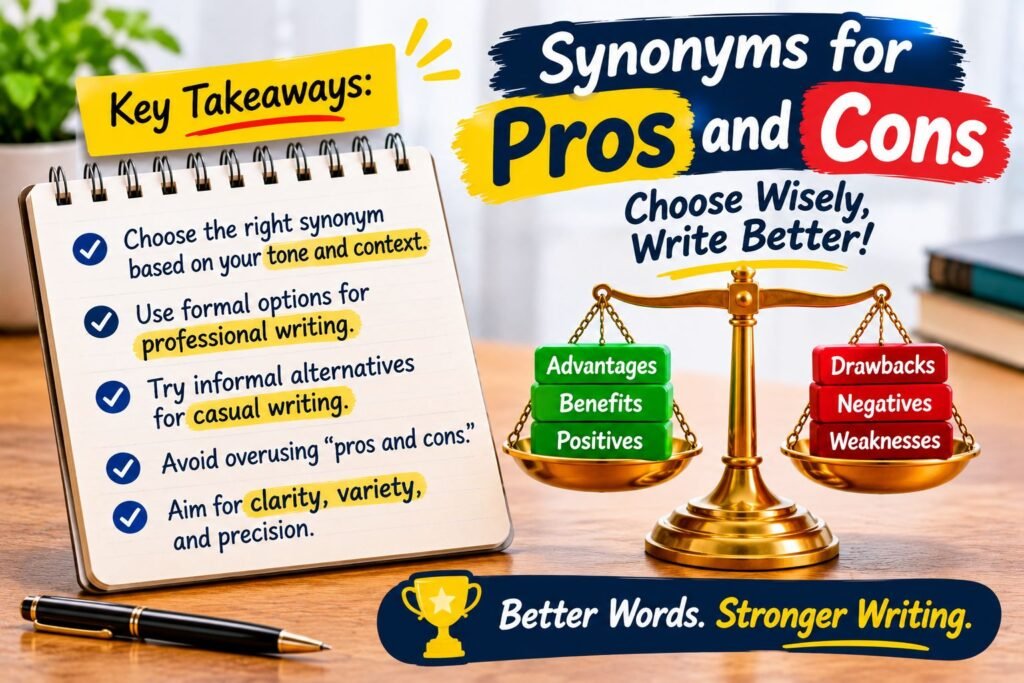
The quick answer: advantages and disadvantages, benefits and drawbacks, positives and negatives, and upsides and downsides are the most common replacements. Which one is best depends on your audience, your tone, and what exactly you are weighing. The sections below sort them so you can find the right one fast.
What Does Pros and Cons Mean?
Core Meaning of Pros and Cons
“Pros and cons” means the arguments for and against something, or the good and bad points of a decision, product, or plan. The terms come from Latin: pro means “for” and contra means “against.” Con is the shortened form of contra.
When you list the pros and cons of working remotely, you are laying out what speaks in its favor (flexibility, no commute) and what speaks against it (isolation, blurred work-life boundaries).
Grammar and Usage Notes
Part of Speech
Both “pro” and “con” work as nouns here. The phrase is a plural noun pair, so it takes a plural verb: “The pros and cons are clear.” In the singular, you can say “one pro” or “a major con.”
Common Sentence Patterns
- “Let’s weigh the pros and cons before we decide.”
- “The main pro of this laptop is battery life.”
- “There are pros and cons to both options.”
- “She made a list of pros and cons.”
Common Collocations
Writers usually pair the phrase with verbs like weigh, consider, list, compare, outline, and discuss. You will also see “the pros and cons of [something]” far more often than any other construction.
When Pros and Cons Sounds Natural
It fits best in conversation, blog posts, product comparisons, and quick decision-making contexts. “Pros and cons of renting vs. buying” sounds right in a headline. It is short, familiar, and easy to scan.
When a Synonym May Work Better
Switch when the setting is formal (a board report, a research paper), when you want a more specific angle (risks vs. rewards, costs vs. benefits), or when the phrase has already appeared several times in the same piece. Repetition is the most common reason to look for another term.
Best Synonyms for Pros and Cons
Common Synonyms for Pros and Cons
These work in almost any context and are safe defaults.
Advantages and Disadvantages
The most direct and widely understood replacement. It is neutral in tone and works in both casual and professional writing. Example: “The advantages and disadvantages of solar panels depend largely on your climate.”
Benefits and Drawbacks
Slightly softer than “advantages and disadvantages,” and very common in business and consumer writing. “Drawbacks” feels less harsh than “disadvantages.” Example: “Each plan has its own benefits and drawbacks.”
Positives and Negatives
Plain and conversational. Works well in reviews, feedback, and informal analysis. Example: “The trip had its positives and negatives, but we’d go again.”
Strengths and Weaknesses
Best when you are evaluating a person, team, strategy, or product’s inherent qualities rather than a decision. Example: “Her proposal’s strengths and weaknesses were discussed in the review.”
Formal Synonyms for Pros and Cons
Use these in reports, proposals, academic papers, and business documents.
Advantages and Disadvantages
Still the safest formal choice. It is precise and almost never questioned by editors.
Benefits and Drawbacks
Appropriate for professional writing, especially in policy and product discussions.
Merits and Demerits
Traditional and somewhat formal. “Merits” is common on its own (“the merits of the case”), but “demerits” is rare in everyday English and can feel dated outside academic, legal, or some regional contexts. Use it sparingly.
Costs and Benefits
Ideal for financial, policy, or business analysis where you are literally weighing what something costs against what it delivers. Example: “A cost-benefit analysis of the new office lease.”
Opportunities and Risks
Works for strategic decisions where the future is uncertain. It shifts the focus from the current state to what might happen. Example: “The report outlines the opportunities and risks of entering the Asian market.”
Informal Synonyms for Pros and Cons
These suit blogs, chats, social posts, and casual conversation.
Upsides and Downsides
Friendly and widely used. Probably the best informal alternative. Example: “The upside is the price. The downside is the setup time.”
Good Points and Bad Points
Simple and direct. Slightly childlike in tone, which can be a plus in friendly, accessible writing.
Pluses and Minuses
Short and snappy. Works well in lists and quick comparisons. Example: “Pluses: lightweight, quiet. Minuses: pricey.”
Highs and Lows
Better for experiences than decisions. It describes the good and bad moments of something, such as a job, a trip, or a season. It is not a strict equivalent, so use it when the sense of “ups and downs” is what you mean.
Strong Synonyms for Pros and Cons
These carry more weight and imply higher stakes.
Strengths and Weaknesses
Also works as a strong pair when the evaluation is serious, as in performance reviews or competitive analysis.
Rewards and Risks
Implies that something valuable is on the line. Common in investing, careers, and ventures. Example: “Starting a business means big rewards and real risks.”
Assets and Liabilities
Rooted in accounting, but used figuratively for anything that helps or hurts. Example: “His experience was an asset; his reputation was a liability.”
Opportunities and Threats
Borrowed from SWOT analysis (Strengths, Weaknesses, Opportunities, Threats). Use it when external factors are the focus, such as markets, competitors, or regulation.
Mild Synonyms for Pros and Cons
When you want to be diplomatic or balanced, these soften the edge.
Positives and Negatives
Mild and neutral, especially in feedback.
Good Points and Bad Points
Gentle and plain.
Benefits and Limitations
“Limitations” is gentler than “drawbacks” or “disadvantages.” It sounds less like a flaw and more like a boundary. Useful when presenting a product or method honestly without sounding negative.
Favorable and Unfavorable Factors
Formal but soft in tone. Good for neutral reports where you want to avoid emotionally loaded words.
Synonyms for Pros and Cons by Context
Everyday Conversation
Choose upsides and downsides, good and bad points, or pluses and minuses. “What are the upsides and downsides of moving to Singapore?”
Professional Writing
Choose advantages and disadvantages, benefits and drawbacks, or costs and benefits. “This section outlines the benefits and drawbacks of each vendor.”
Academic Writing
Choose advantages and disadvantages, strengths and limitations, or merits and limitations. Academic writing prefers measured language, so avoid slangy options like “pluses and minuses.” “The study discusses the strengths and limitations of self-reported data.”
Marketing Copy
Marketers rarely write “drawbacks” about their own product, but they do compare options honestly in guides and comparison pages. Use benefits and trade-offs, what you gain and what to know, or upsides and considerations. These keep the tone honest without being discouraging.
Personal Communication
In emails, messages, or advice to a friend, good and bad sides, upsides and downsides, or simply “what’s good and what’s not” feel warm and natural.
Another Word for Pros and Cons in a Sentence
Seeing the swaps in action helps:
| Original | Alternative |
| We listed the pros and cons of each laptop. | We listed the advantages and disadvantages of each laptop. |
| Let’s discuss the pros and cons. | Let’s discuss the upsides and downsides. |
| The pros and cons of remote work are well known. | The benefits and drawbacks of remote work are well known. |
| She weighed the pros and cons of the job offer. | She weighed the rewards and risks of the job offer. |
| Here are the pros and cons of this method. | Here are the strengths and limitations of this method. |
Pros and Cons Synonyms Compared
| Synonym pair | Tone | Best for | Intensity |
| Advantages / Disadvantages | Neutral-formal | Reports, essays | Medium |
| Benefits / Drawbacks | Neutral | Business, consumer writing | Medium |
| Positives / Negatives | Casual-neutral | Reviews, feedback | Mild |
| Upsides / Downsides | Casual | Blogs, conversation | Mild |
| Strengths / Weaknesses | Neutral | People, products, strategies | Medium-strong |
| Costs / Benefits | Formal | Finance, policy | Strong |
| Rewards / Risks | Neutral-strong | Investing, ventures | Strong |
| Merits / Demerits | Formal, dated | Academic, legal | Medium |
Words Similar to Pros and Cons
These are related terms. They do not replace “pros and cons” one-for-one, but they appear in the same conversations.
Trade-Offs
What you give up to get something else. “The trade-off for lower rent is a longer commute.” A trade-off is a relationship between a pro and a con, not a list of both.
Evaluation
The act of judging something’s worth. A pros-and-cons list is often part of an evaluation.
Assessment
A structured judgment, often formal. “A risk assessment.”
Considerations
Things to think about before deciding. They can be positive, negative, or neutral. “Key considerations before you buy.”
Factors
Elements that influence an outcome. Like considerations, they are not inherently good or bad.
Antonyms of Pros and Cons
There is no true one-word opposite, since the phrase already contains both sides. If you want the idea of not weighing both sides, you could use:
- One-sided view or bias
- Unqualified endorsement (only pros)
- Blanket criticism (only cons)
- Certainty, in the sense of a decision that needs no weighing
Individually, the opposite of pro is con, and the opposite of advantage is disadvantage.
How to Choose the Right Synonym for Pros and Cons
Match the Context
A board memo and a group chat need different vocabulary. Decide where the words will live first.
Match the Tone
Formal, friendly, neutral, or persuasive? “Upsides and downsides” and “merits and demerits” sit at opposite ends.
Check the Intensity
“Disadvantages” is stronger than “limitations.” “Risks” is stronger than “considerations.” Pick the level that matches how serious the issue really is.
Think About the Reader
A general audience prefers familiar words. A specialist audience may expect precise terms like “costs and benefits” or “opportunities and threats.”
Check Whether the Synonym Is Exact
“Strengths and weaknesses” describes qualities. “Pros and cons” describes arguments for and against a choice. They overlap, but they are not identical. If you are weighing a decision, “advantages and disadvantages” is closer.
Keep the Sentence Natural
Read the sentence aloud. If the replacement sounds stiff or forced, go back to the simpler option.
Favor Clarity
If a fancy alternative makes the reader pause, it is not an improvement. Clear beats clever.
Common Mistakes When Using Synonyms for Pros and Cons
Choosing a Word with the Wrong Tone
“Merits and demerits” in a casual text message feels oddly stiff.
Using a Synonym That Is Too Strong
Calling the downsides of switching email providers “liabilities” or “threats” overstates the issue.
Using a Formal Word in Casual Writing
“Opportunities and risks” in a lighthearted lifestyle post can sound like a consulting report.
Using a Casual Word in Professional Writing
“Pluses and minuses” in a formal proposal may look careless.
Replacing the Phrase Without Checking Meaning
“Highs and lows” does not mean the same thing as “pros and cons.” One describes experiences over time, the other describes arguments about a choice.
Treating Related Words as Exact Synonyms
Trade-offs, factors, and considerations are related, but they are not interchangeable with pros and cons.
Making the Sentence Sound Unnatural
Swapping the phrase mechanically can break the rhythm. “We weighed the favorable and unfavorable factors of lunch” sounds odd. “We weighed the pros and cons of lunch spots” is fine.
Quick Synonym List for Pros and Cons
Common Synonyms
Advantages and disadvantages, benefits and drawbacks, positives and negatives, strengths and weaknesses
Formal Synonyms
Merits and demerits, costs and benefits, opportunities and risks, favorable and unfavorable factors
Informal Synonyms
Upsides and downsides, good points and bad points, pluses and minuses, highs and lows
Strong Synonyms
Rewards and risks, assets and liabilities, opportunities and threats
Mild Synonyms
Benefits and limitations, positives and negatives, good points and bad points
Related Words
Trade-offs, evaluation, assessment, considerations, factors
Frequently Asked Questions
What is a good synonym for pros and cons?
“Advantages and disadvantages” is the most dependable choice. For casual writing, “upsides and downsides” works well.
What are some common synonyms for pros and cons?
Advantages and disadvantages, benefits and drawbacks, positives and negatives, strengths and weaknesses, and upsides and downsides.
What is another word for pros and cons?
Besides the pairs above, you can say “trade-offs” (when something is gained at a cost) or “considerations” (when the points are neutral).
What is another way to say pros and cons?
You can rephrase it entirely: “the good and the bad,” “what works and what doesn’t,” or “reasons for and against.”
What is a formal synonym for pros and cons?
Advantages and disadvantages, costs and benefits, or merits and limitations.
What is a synonym for con?
Drawback, disadvantage, downside, minus, negative, limitation, or shortcoming.
What is a pro and con synonym?
For a pro: advantage, benefit, upside, plus, positive, merit. For a con: disadvantage, drawback, downside, minus, negative, flaw.
What are other words for pros and cons?
See the quick synonym list above: it covers common, formal, informal, strong, and mild options.
What is the best synonym for pros and cons?
There is no single best one. “Advantages and disadvantages” is the safest overall, and “upsides and downsides” is best for casual writing.
What is an informal synonym for pros and cons?
Upsides and downsides, pluses and minuses, or good points and bad points.
What is a stronger word for pros and cons?
Rewards and risks, assets and liabilities, or opportunities and threats.
What is a milder word for pros and cons?
Benefits and limitations, or positives and negatives.
What words are similar to pros and cons?
Trade-offs, considerations, factors, evaluation, and assessment.
What is the opposite of pros and cons?
There is no direct opposite. A one-sided view, such as pure praise or pure criticism, is the closest idea.
How do I choose the right synonym for pros and cons?
Match the tone and context, check the intensity, and prefer the clearest option for your reader.
What is another word for cons only?
Drawbacks, disadvantages, downsides, negatives, limitations, or shortcomings.
Conclusion
Finding synonyms for pros and cons is less about avoiding a phrase and more about picking the right tool. “Advantages and disadvantages” keeps things professional. “Upsides and downsides” keeps them friendly. “Costs and benefits” suits analysis, and “rewards and risks” suits ventures with real stakes.
Before you swap, ask what you are actually weighing: a decision, a set of qualities, or an experience. Match the word to that, check the tone, and read the sentence aloud. If it sounds natural and the reader understands it instantly, you have chosen well.
1 thought on “Synonyms for Pros and Cons | Smarter Alternatives for Clear, Powerful & Professional Writing in 2026 ”