
The El Salvador flag looks simple: two blue stripes, one white stripe, and a small emblem in the middle. But that design carries a story of independence, regional unity, and national pride. Today the same flag also lives on your phone as the 🇸🇻 emoji, where people use it to show roots, love for home, travel memories, or support for Salvadoran culture.
This guide covers what the flag means, where it comes from, how people use the emoji in chats and bios, and when to think twice before posting it.
El Salvador Flag Symbol Meaning – Quick Meaning
At its simplest, the flag says: this is El Salvador, and I’m proud of it. In text and social media, 🇸🇻 works as a shorthand for home, heritage, and belonging.
Core meanings:
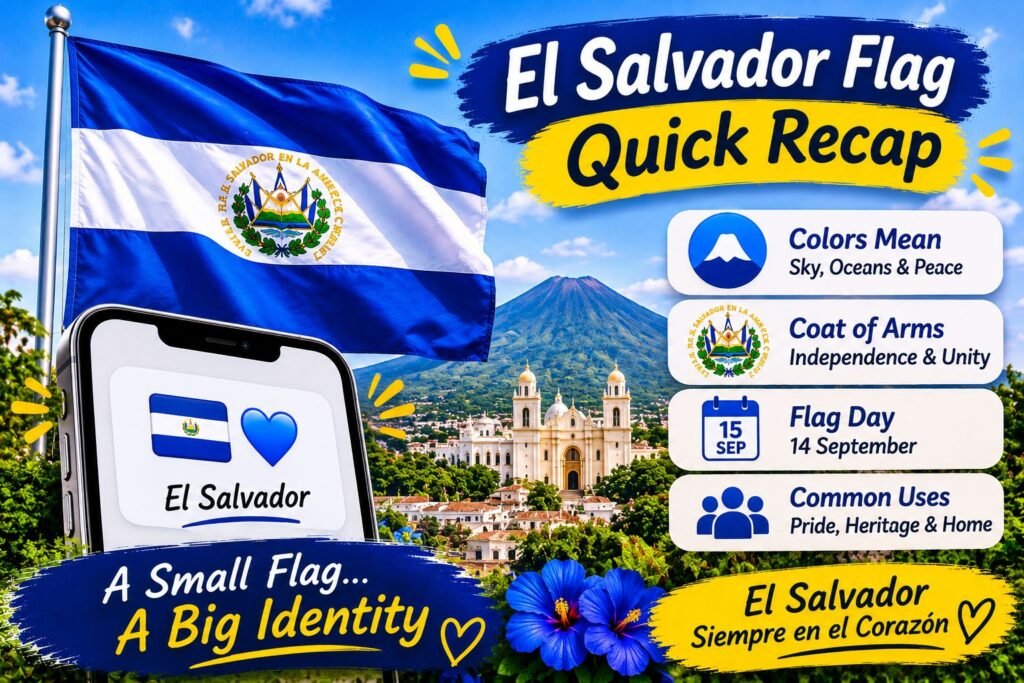
- Blue: commonly explained as the sky and the two oceans that frame Central America, the Pacific and the Caribbean.
- White: peace, and the space between the two bodies of water.
- The coat of arms: independence, liberty, and the union of Central American nations.
- The motto “Dios, Unión, Libertad”: God, Union, Liberty.
Simple interpretation:
If someone sends you 🇸🇻, they are almost always saying “I’m Salvadoran,” “I’m from there,” “my family is from there,” or “I’m celebrating El Salvador.” It’s rarely deeper than that unless the conversation gives it a different context.
El Salvador Flag symbol Meaning–Origin & Background
The flag’s roots go back to the early 1800s. After Central America declared independence from Spain on 15 September 1821, the region briefly formed the Federal Republic of Central America (1823–1841). Its flag used blue and white horizontal bands, and several member states, including El Salvador, kept that blue-white-blue look after the federation fell apart.
El Salvador has used several flag versions over time, including a period with a different color scheme in the 19th century. The current design with the blue-white-blue bands and the national coat of arms was formalized in 1912. The coat of arms contains a triangle with five volcanoes, a Phrygian cap radiating light, a rainbow, and a laurel wreath, all framed by the words República de El Salvador en la América Central. The date 15 de septiembre de 1821 appears on it too.
The five volcanoes are usually said to represent the five original members of the Federal Republic: Guatemala, El Salvador, Honduras, Nicaragua, and Costa Rica. That detail explains why the flag is as much about a shared Central American past as about one country.
Flag Day (Día de la Bandera) is celebrated in El Salvador on 14 September, the day before Independence Day.
Cultural influence
The flag shows up everywhere in Salvadoran life: school ceremonies, football matches, patriotic holidays, and neighborhood celebrations. Salvadorans abroad, especially in the United States, hang it in homes, restaurants, and cars. It’s also common on pupuserías and at community events, which makes it a symbol of identity far from home as well as inside the country.
Social media impact of El Salvador Flag Symbol Meaning
On social platforms, 🇸🇻 became a quick way to say “I’m repping my roots.” You’ll see it in:
- Instagram and TikTok bios, often next to a city or a heart
- Captions on food posts (pupusas, yuca frita, horchata)
- Comments under travel videos, football highlights, or music
- Hashtags for Salvadoran heritage and diaspora communities
A single emoji does the work of a sentence, which is why it spread so quickly.
El Salvador flag emoji–Real-Life Conversations
Here is how the emoji actually looks in everyday chats.
1. WhatsApp Chat
Marisol: Guess who just landed in San Salvador 🇸🇻
Dani: NO WAY. For how long?
Marisol: Two weeks. Mom is already cooking enough pupusas for twenty people
Dani: Save me some 😭
2. Instagram DM
Luis: Your story with the volcano view, where is that?
Karen: Santa Ana, near Lake Coatepeque 🇸🇻 you have to go
Luis: Adding it to my list, thanks
3. TikTok Comments
user1: Anyone else Salvadoran and crying at this song? 🇸🇻
user2: Reporting in from Los Angeles 🇸🇻🇸🇻
user3: My abuela used to play this every Sunday 🥹
4. Text Message
Alex: Why’s your bio say 🇸🇻?
Rene: My parents are from La Libertad. Born here, but that’s home too
Alex: That’s cool, I never knew
Emotional & Psychological Meaning
Flags tend to carry more emotional weight than most emojis because they stand for belonging. For many people, 🇸🇻 expresses pride, nostalgia, family, and sometimes longing. For members of the diaspora, it can quietly say “I may live somewhere else, but I’m still connected.”
Psychologists who study identity often point to symbols like flags as ways people signal group belonging. Posting one is a small way of saying who you are and where you’re from, without writing a paragraph.
Real-life scenario:
Someone who moved abroad as a child posts a photo from their first trip back to El Salvador with only 🇸🇻 as the caption. It isn’t a tourism post. It’s a homecoming, and the emoji says what words would struggle to.
Usage in Different Contexts
Social media
Common uses include bios, heritage posts, football support, food content, music and culture pages, and travel photos. It’s usually positive and low-key.
Friends & relationships
Between friends and family it’s warm shorthand: “this reminds me of home,” “let’s meet at the Salvadoran restaurant,” or “my family’s roots.” In romantic contexts, it can mean someone is proud of their background or is sharing a piece of their culture with you.
Work / professional settings
In professional bios or LinkedIn, a flag can signal cultural background or international experience. It’s generally fine, but keep it light. In formal emails, a flag emoji is unnecessary and may come across as casual.
Casual vs serious tone
Casual: 🇸🇻 in a caption, bio, or chat is friendly and relaxed. Serious: when used during a national event, a tragedy, or a political discussion, the flag can feel weightier, so match the tone of the conversation rather than dropping it in.
When NOT to Use It
- When you have no connection to El Salvador and you’re using it to be funny or to stereotype
- In mocking or insulting posts about the country or its people
- In heated political arguments, where a flag can read as taking a side
- During sensitive moments like disasters or tragedies, unless you’re expressing sympathy or solidarity
- In formal business writing, where emojis generally don’t belong
If you’re unsure, ask yourself whether you’d be comfortable if a Salvadoran friend saw how you used it.
SV Meaning–Common Misunderstandings
Common mistakes:
- Confusing it with Nicaragua’s or Honduras’s flag. All three share blue-and-white imagery. Nicaragua’s flag also has a triangle with volcanoes and a rainbow, so it looks very similar at a small size. Honduras has five blue stars on a white band instead of a coat of arms.
- Assuming the Caribbean is on El Salvador’s coast. The country only has a Pacific coastline. The blue stripes are a regional symbol.
- Treating it as just a color scheme. The emblem and motto carry the history.
Tone confusion:
Because the emoji is so short, it can be read as pride, nostalgia, a joke, or a political statement depending on context. A friendly “🇸🇻” in a bio is not the same as “🇸🇻” posted as the entire reply in a tense debate.
Comparison Table
| Flag | Main Design | Key Detail |
| 🇸🇻 El Salvador | Blue-white-blue horizontal stripes | Coat of arms with triangle, volcanoes, Phrygian cap, rainbow |
| 🇳🇮 Nicaragua | Blue-white-blue horizontal stripes | Similar triangle emblem; wording on emblem differs |
| 🇭🇳 Honduras | Blue-white-blue horizontal stripes | Five blue stars in the center |
| 🇬🇹 Guatemala | Vertical blue-white-blue | Quetzal bird and crossed rifles |
Opposite expression:
There isn’t a true “opposite” of a national flag emoji, but the closest contrast would be a neutral globe emoji 🌎, which signals “from everywhere” rather than from one place, or a different country’s flag.
Key Insight:
The flag is not about being exclusive. For most users it’s about connection, and the same symbol that says “I’m from here” often also says “welcome to my culture.”
How to Respond When Someone Uses It
Casual replies:
- “Nice! Which part of El Salvador?”
- “Love that, how often do you get back?”
- “Represent 🇸🇻”
Funny replies:
- “Now I’m hungry for pupusas”
- “Okay but where’s my invitation to the family dinner?”
Mature replies:
- “It sounds like home means a lot to you.”
- “I’d love to hear more about your culture.”
Respectful replies:
- “Thanks for sharing that.”
- “That’s a beautiful flag and a beautiful country.”
Skip assumptions about politics or stereotypes. Curiosity goes much further than guesses.
Regional & Cultural Usage
Western culture:
In the US, Canada, and Europe, the emoji is mostly used by Salvadoran diaspora communities and friends, often for heritage, food, and family.
Asian culture:
Use is less frequent because there’s less direct connection, but flags are widely understood as national symbols in chat. It may appear in sports talk, travel posts, or international friendships.
Middle Eastern culture:
Similar to Asia: it’s recognized as a country flag, and usage tends to be tied to travel, friendships, or global events instead of heritage.
Global internet usage:
Across platforms, flag emojis function as identity badges. They’re also used for football tournaments, international events, and travel content. Note that on some Windows devices, flag emojis may appear as two letters (“SV”) instead of a colored flag.
Generational differences:
Younger users tend to use it as a bio tag or caption accent. Older family members may use it more sincerely, in messages tied to family, church, or national celebrations.
El Salvador Flag Emoji-Is It Safe for Kids?
Yes. The flag emoji itself is completely child-friendly. It’s a national symbol with no inappropriate meaning. Parents can use it to talk about geography, culture, and where family members come from. The only caution is the same as with any emoji: the surrounding conversation matters more than the symbol.
Frequently Asked Question’s
1. What does 🇸🇻 mean?
It’s the El Salvador flag emoji. People use it to show they are from El Salvador, have family roots there, are traveling there, or want to celebrate the country.
2. What are the colors of the El Salvador flag?
Blue and white: two blue horizontal stripes with a white stripe between them, plus a multi-colored coat of arms at the center.
3. Why is the El Salvador flag important?
It represents independence, national identity, and the historic unity of Central America. The motto and the five volcanoes reflect that shared history.
4. Is 🇸🇻 a slang emoji?
No. It’s a standard flag emoji, not slang. Its meaning is straightforward, though tone can vary by context.
5. Where is El Salvador located?
El Salvador is in Central America, bordered by Guatemala and Honduras, with a coastline on the Pacific Ocean. Its capital is San Salvador, and it is the smallest country in mainland Central America.
6. Can I use 🇸🇻 in social media bios?
Yes, if it reflects your background, interests, or support. It’s widely used in bios to show heritage or pride.
7. Does the flag have political meaning?
The flag itself is a national symbol, not a political party symbol. But like any national flag, it can take on political meaning in certain debates, so context matters.
Conclusion
The El Salvador flag is a small piece of cloth with a large story: independence from Spain, a shared Central American past, and a modern identity carried by people at home and abroad. As an emoji, 🇸🇻 does the same work in a single character. It says “this is where I’m from” or “this is what I love.”
Use it with the same respect you’d give the real flag, and when someone else uses it, a simple question about their story is usually the best reply.